White Gold Cameo Jewelry Sets: How Old Is Yours Really?
Identify Your Jewelry Piece Instantly
Unsure about a hallmark, gemstone cut, or metal stamp? Take a photo and get an instant AI analysis and appraisal.

💡 Key Takeaways (Quick Reference)
- The mount dates the set, not the cameo. White gold was patented in the 1910s and became common in the 1920s, so a white gold cameo set is twentieth-century or later.
- Nineteenth-century cameo sets are yellow gold. Earlier white-looking sets are silver, silver over gold, or cut steel; platinum takes over around 1900.
- The stamp gives the karat, never the colour. 14K white gold and 14K yellow gold carry the same mark.
- Matched or assembled? One carver’s hand, one material, one mount design and one metal across every piece. Then date the earring backs.
Searches for a cameo white gold jewelry set usually come from someone holding a cameo necklace, earrings and ring or brooch in a pale metal and wondering whether it is a Victorian parure. The cameo cannot answer that alone, because cameos are carved for decades in the same classical styles and are often reset. The metal and the fittings can. This guide reads them in order. For the cameo itself, shell or stone, start with our antique cameo identification guide.
Step 1: Name the White Metal
A white-looking mount can be one of five materials, and each one opens at a different point in history.
| Mount | How it looks | When it appears on cameo jewelry | What to look for |
|---|---|---|---|
| Yellow or rose gold | Warm yellow | The norm for 19th-century cameo sets | Karat marks where the country required them |
| Silver, or silver over gold | Grey-white, tarnishes dark | Silver mounts on cameos for centuries; silver-faced gold for diamond settings until about 1900 | 925, STERLING, 800; a gold back behind a silver face |
| Cut steel | Grey mirror-white studs | Georgian and 19th-century sets | Riveted facets; pulls to a magnet |
| Platinum | Cool grey-white, does not tarnish | From the late 19th century; the leading white metal from about 1900 | PLAT, Pt950, IRIDPLAT; very heavy for its size |
| White gold | Bright white, often rhodium plated | From the 1920s | 14K, 18K, 585, 750, with no colour mark |
Two dates in this table needed reconciling:
- Platinum. One history puts platinum into jewelry in the mid-19th century, once furnaces ran hot enough; dealer accounts date its takeover of diamond settings from silver-topped gold anywhere from the 1870s to about 1900. Read it as late 19th century onward, and dominant from about 1900.
- White gold. The alloy was patented in Pforzheim, Germany, by Karl Richter; sources give 1912 or 1915. In the United States, the New York firm of David Belais promoted 18K white gold from about 1917 to 1918, although its patent was struck down in 1926 because others had got there first. Either way, white gold became a common jewelry metal in the 1920s, sold as a cheaper alternative to platinum.
The First World War helped it along. Platinum was needed for the war effort: by 1917 the British government controlled the whole supply, and in the United States platinum fell under the Explosives Act, which barred its use in making or repairing jewelry. White gold filled the gap.
Step 2: Read the Stamps
Turn each piece over and use a 10x loupe on the clasp tongue, the brooch pin bar, the earring backs and the inside of any ring shank.
- White gold has no colour mark. It is stamped exactly like yellow gold: 14K or 585, 18K or 750. Our white gold wedding band guide explains what the alloy is and why a plated white surface wears through to a faintly yellow one.
- Platinum reads PLAT, Pt950 or 950 PLAT. Older platinum often carries IRIDPLAT, 10% IRID or similar: an alloy of about 90% platinum and 10% iridium. A bench jeweler’s reference says that stamp was used until the mid-1970s, so it marks a piece as older, not as antique. Weight separates platinum from white gold; see our platinum vs. white gold guide.
- Silver reads 925 or STERLING; much Continental silver reads 800. British silver carries a full hallmark that dates it, explained in our British sterling silver hallmarks guide.
If the pieces of a “set” carry different marks, say 14K on the brooch and 925 on the earrings, they were not made together.
Step 3: Decide Whether It Is a Set at All
A parure is a complete matching set made to be worn together, typically necklace, earrings, brooch and bracelet, and sometimes a tiara. A demi-parure is a smaller matching set, and here references differ: some accept any two matching pieces, others expect three, usually a brooch or necklace with earrings. Either way, the test is whether the pieces were made as one, or were brought together later.
Signs of a set made as one:
- One material and one hand. Every cameo is the same shell or the same stone, with the same colour of ground and the same carving style.
- One mount design. The same frame, the same wire or leaf work, the same metal colour on every piece.
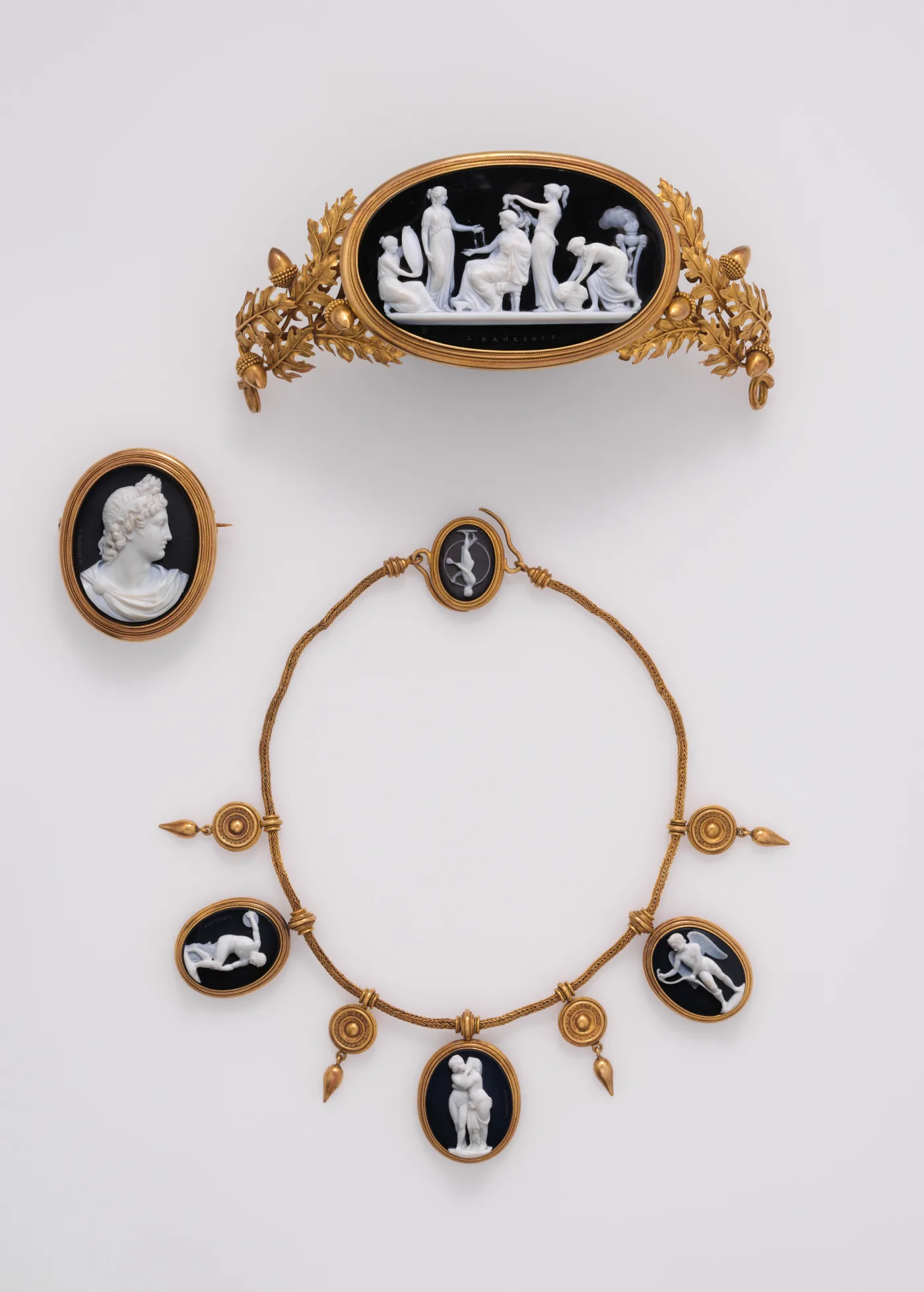
- Graduated sizes. Larger cameos at the centre and smaller ones at the clasp and ears, as on the Saulini necklace above.
- The original fitted case, shaped to the pieces, is the strongest evidence of all.
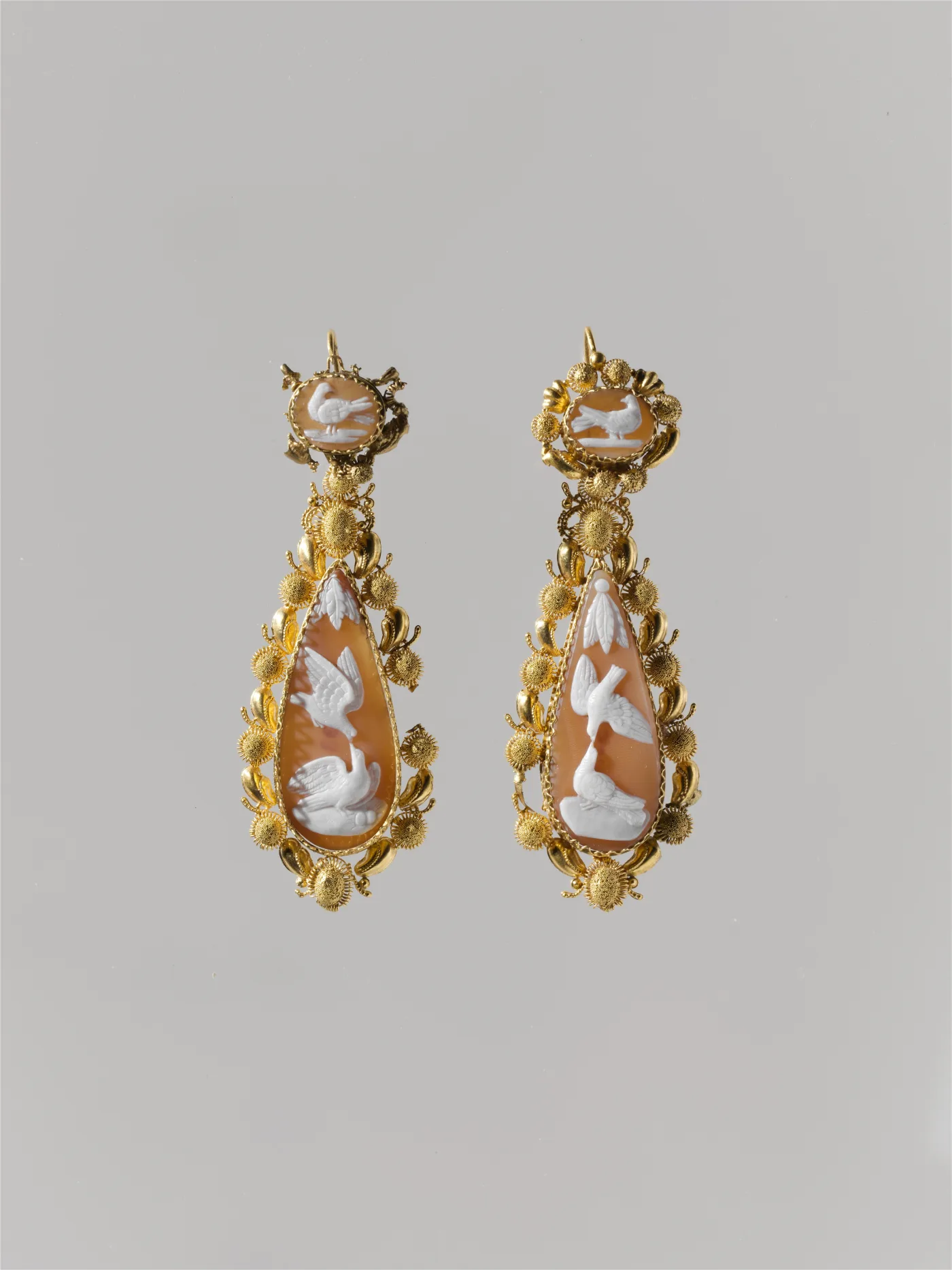
An assembled set gives itself away through mismatches: a shell cameo next to a stone one, a pink ground beside a brown one, different frame profiles, or one piece in white gold and another in silver.
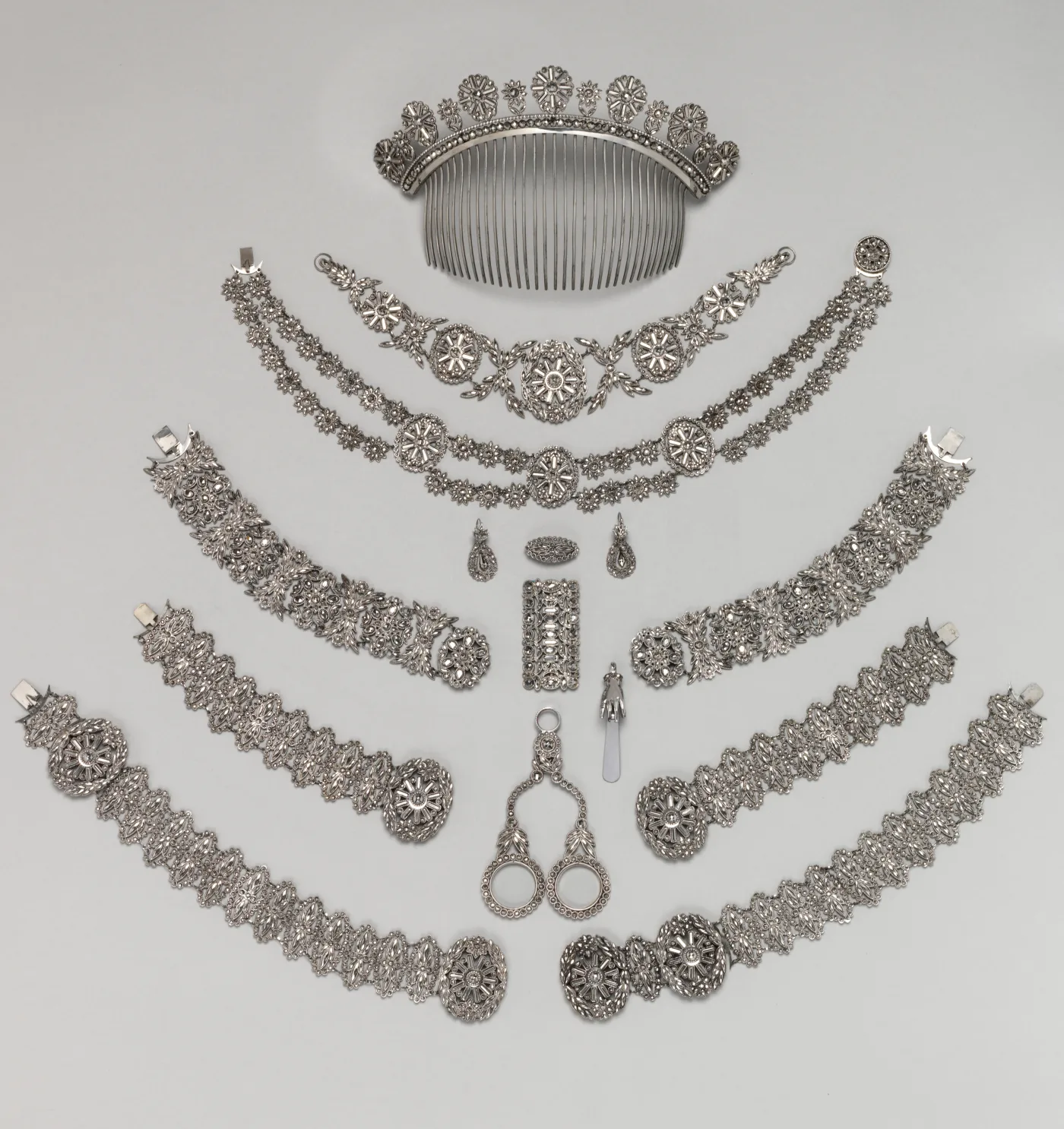
Step 4: Date the Earring Backs
Earrings are the piece of a set whose fittings change most, and their backs give an earliest possible date. A patent date is not an adoption date: the screw-back was patented in 1894 but did not come into common use until after about 1909.
| Earring fitting | Earliest date | What it suggests |
|---|---|---|
| Kidney wire | Late Victorian, about 1880 | Pierced ears; European work |
| Screw-back | Patent 1894 | Common from about 1910 into the mid-century |
| Clip-back | Patented in the US in 1934 | Mostly 1934 onward; some sources see hinged clips in the late 1920s |
| Omega back | 1960s | A reliable “not antique” marker |
Our brooch clasp and hinge dating guide gives the full sequence, including the brooch catches.
Fittings get replaced, so read the whole set. A white gold set with screw-back earrings and a safety-catch brooch is consistent with the 1920s to 1950s. A yellow gold set with hook earrings and a C-catch brooch fits the 19th century. And a white gold set with clip or omega backs is mid-20th century or later, whatever the cameo looks like.
Putting It Together
A cameo jewelry set in white gold is almost always a twentieth-century set. Sometimes it is a modern mount around an older cameo, which is common, because cameos outlive their settings. That does not make it worthless: a matched set with hand-carved cameos and solid 14K or 18K mounts is a good piece of jewelry. It does mean the word Victorian belongs on yellow gold, silver or cut steel. For a ring from a set, our gold cameo ring guide reads the shank stamps, and our cameo portrait dating guide dates the carving itself.
Frequently Asked Questions
Is a cameo set in white gold antique?
Rarely in the Victorian sense. White gold was patented in Germany in the 1910s and only became common in jewelry in the 1920s, when it was sold as a cheaper alternative to platinum. A cameo set mounted in white gold therefore dates from about the 1920s or later, even when the cameo itself is older and has been remounted.
What is the difference between a parure and a demi-parure?
A parure is a complete matching set made to be worn together, typically a necklace, earrings, brooch and bracelet, sometimes with a tiara. A demi-parure is a smaller matching set. Definitions of the smaller set differ: some references accept two matching pieces, others expect three, usually a brooch or necklace with matching earrings.
What stamps should I look for on a white metal cameo set?
White gold carries an ordinary karat mark such as 14K, 18K, 585 or 750; there is no separate mark for the colour. Platinum is stamped PLAT, Pt950 or, on older pieces, IRIDPLAT or 10% IRID for a platinum-iridium alloy. Sterling silver reads 925 or STERLING, and much Continental silver reads 800.
Identify Your Jewelry Piece Instantly
Unsure about a hallmark, gemstone cut, or metal stamp? Take a photo and get an instant AI analysis and appraisal.