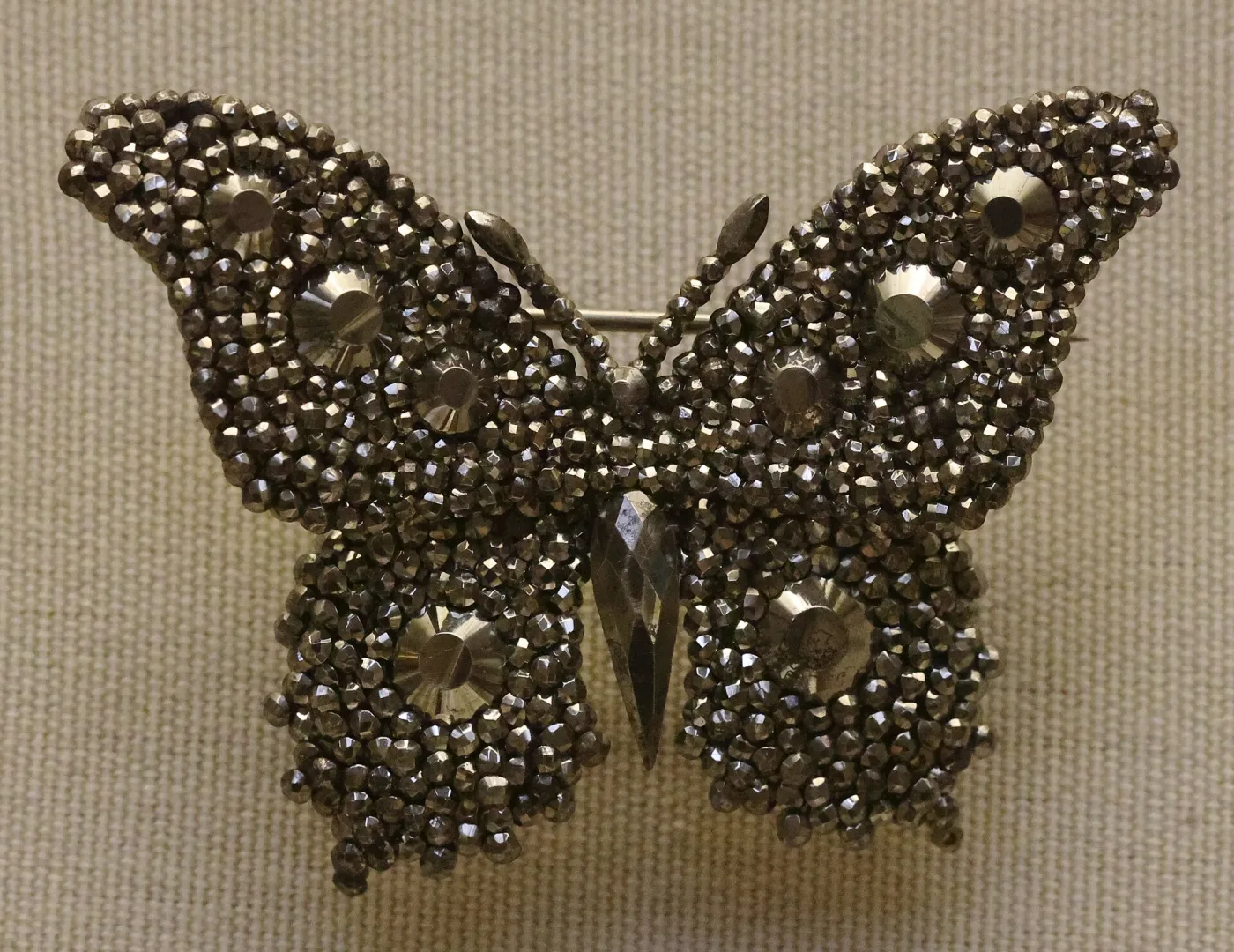
Cut Steel vs. Marcasite: Identification & Dating Guide
💡 Key Takeaways (Quick Reference)
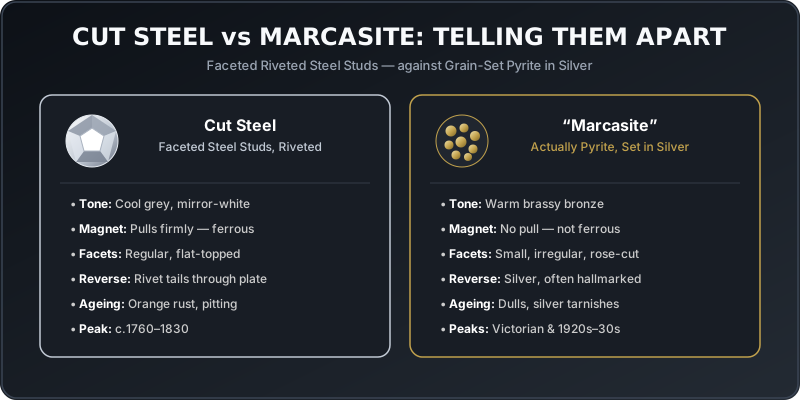
- Colour: Cut steel is a cool grey mirror-white; marcasite is a warm brassy bronze.
- Magnet: Cut steel pulls firmly. Marcasite does not — pyrite is not ferromagnetic.
- The reverse decides it: cut steel shows rivet tails through a pierced plate; marcasite shows silver settings, often with British hallmarks.
- Marcasite is not marcasite. It is pyrite, and has been since before the two minerals were told apart in 1845.
Two grey-glittering antiques get confused more often than almost anything else in a tray of Georgian and Victorian jewellery. Both throw a metallic, diamond-ish sparkle without a single gemstone; both go dark and unremarkable in a photograph. But one is faceted iron riveted to a plate, and the other is a mineral set into silver — and once you know where to look, they are not remotely alike.
First, the Name Is Wrong
Jewellery sold as marcasite is not marcasite. It is pyrite — the same iron sulphide, FeS₂, but crystallised in the cubic system rather than the orthorhombic one. Actual marcasite is brittle, prone to crumbling, and can react with atmospheric moisture; nobody would build an earring out of it.
The confusion is historical, not commercial. Until the early nineteenth century “marcasite” covered pyrite, marcasite and assorted other yellow iron sulphides indiscriminately; the two were only formally separated in 1845, and the trade never updated its vocabulary. A dealer saying marcasite means pyrite and is not misleading you — but mineral references and jewellery references now describe two different substances under one word.
Technical Comparison Matrix
| Property | Cut Steel | “Marcasite” (Pyrite) |
|---|---|---|
| Material | Faceted carbon steel studs | Pyrite, FeS₂, cubic system |
| Colour | Cool grey, mirror-white | Warm brassy bronze-yellow |
| Unit size | Larger, typically 2–6 mm | Small, typically 1–3 mm |
| Facet pattern | Regular, flat-topped, machine-even | Irregular rose-cut domes |
| Attachment | Riveted (early: screwed) through a plate | Grain-, bead- or prong-set in metal |
| Mount metal | Brass, tin or silver alloy backplate | Silver, occasionally gold |
| Magnet response | Strong pull | None detectable |
| Failure mode | Orange rust, pitting, lost studs | Stones dull or drop; silver tarnishes |
| Peak fashion | c.1760–1830 | Victorian, then 1920s–30s |
Five Checks That Settle It
1. Look at the Colour Before Anything Else
In daylight, cut steel is the colour of a polished nail head: grey, cold, faintly blue. Pyrite is unmistakably warm — brass, bronze, old gold. This settles most pieces in seconds, and it is the check photographs destroy: white balance and artificial light push both toward the same neutral grey. Judge colour in the hand, never from a listing photograph.
2. Read the Facet Geometry
Cut steel studs are individually hand-faceted like tiny gemstones, with a flat table on top and angled facets falling away around it. Under magnification they are strikingly regular, and you can often see the tool marks.
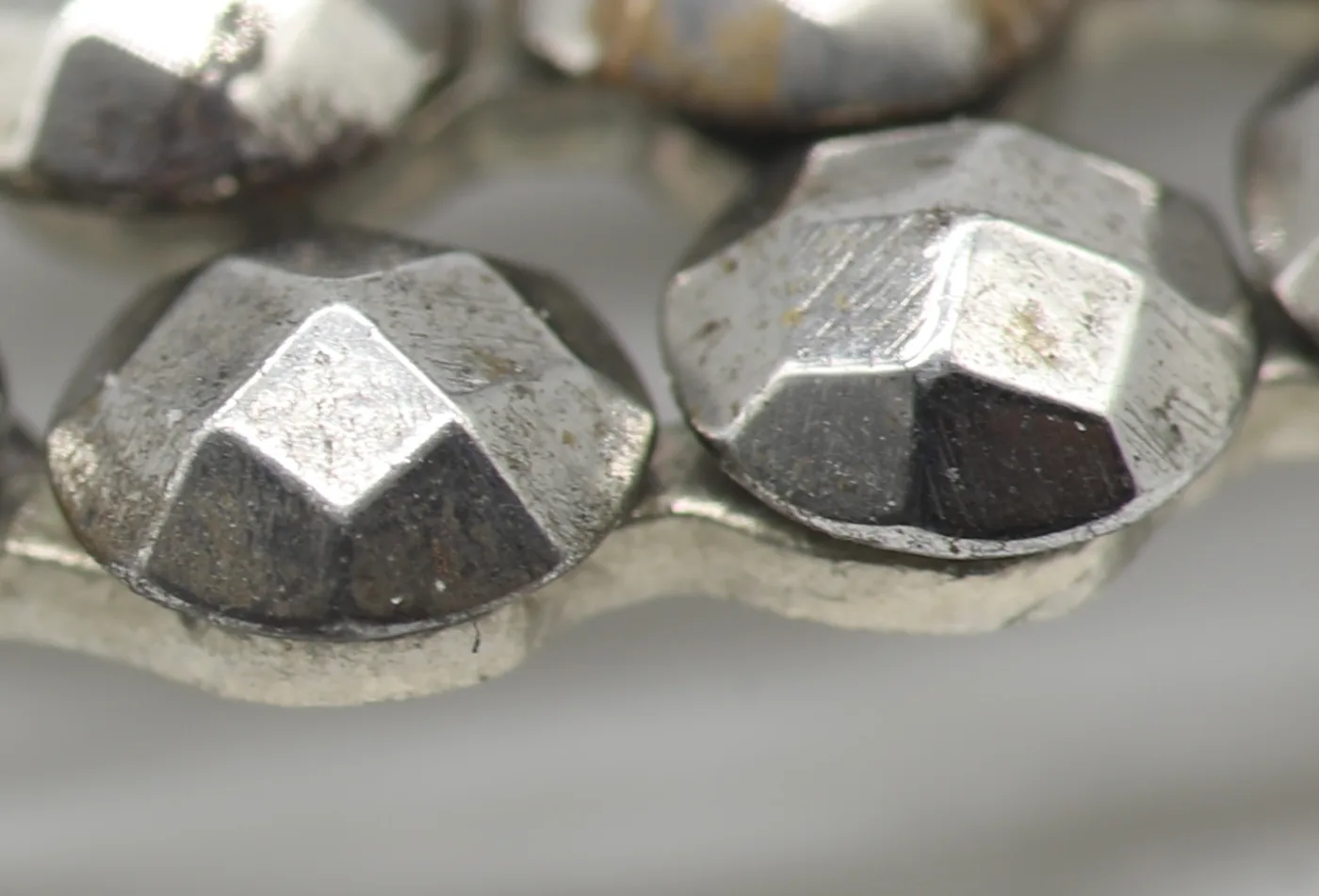

Pyrite is cut too, but as small rose-cut domes, and the results are far less uniform. Individual stones vary in outline and height because each was cut to fit its seat.

3. Turn It Over — This Is the Real Test
The front can deceive. The back cannot. Cut steel studs are riveted through a pierced backplate, and the peened rivet tails are plainly visible from behind, one per stud, in the same pattern as the sparkle on the front.
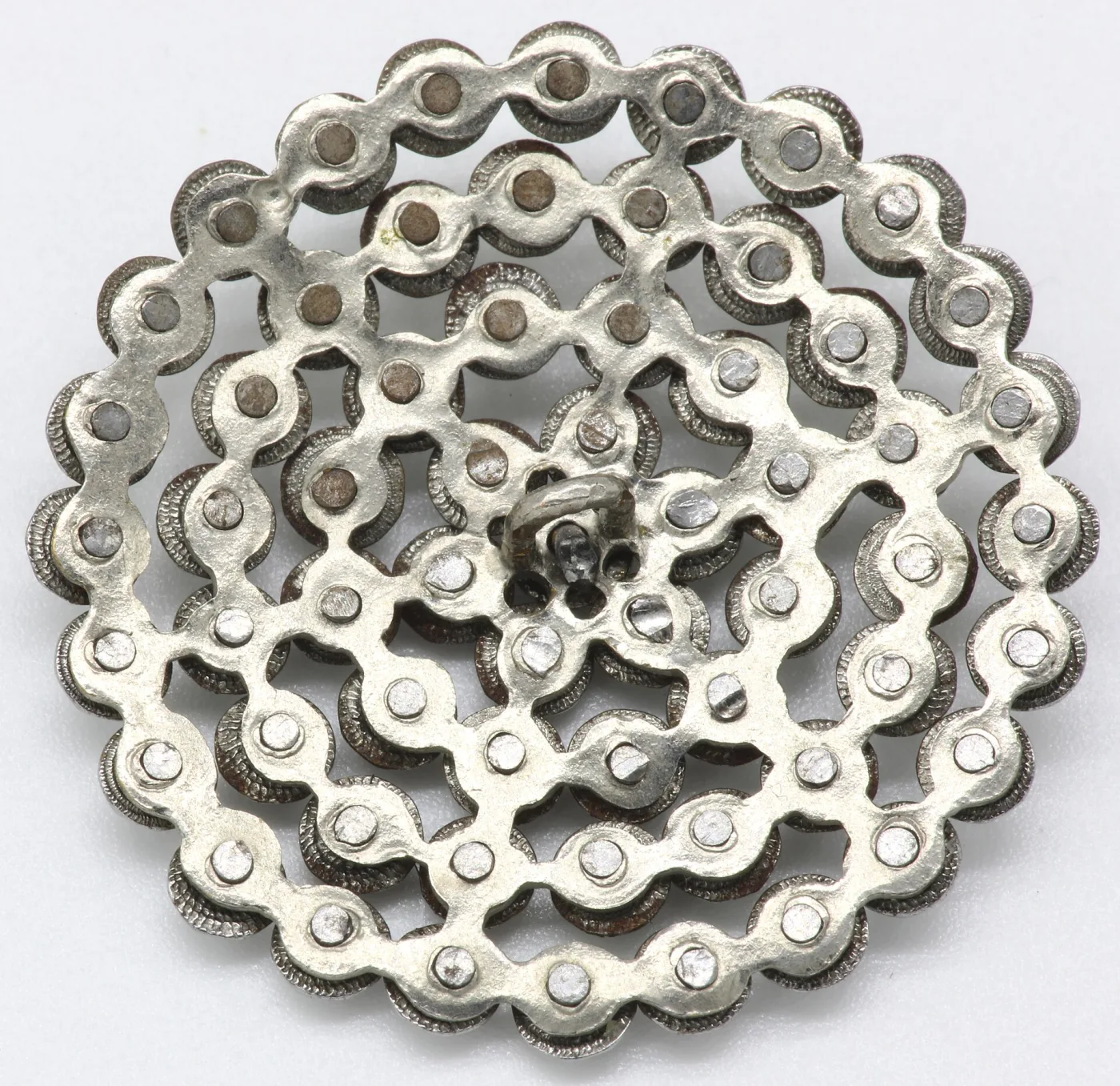

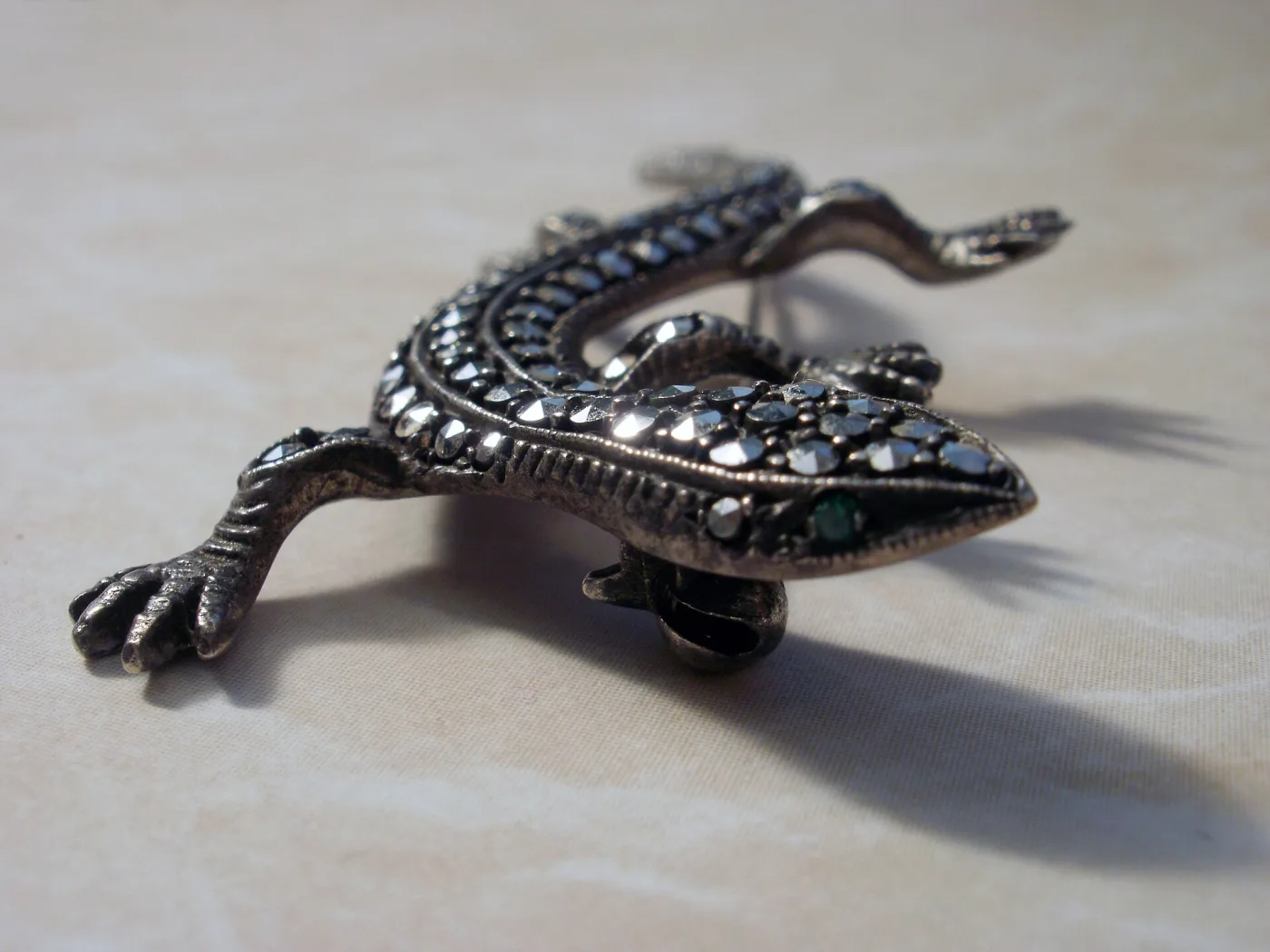
Marcasite shows the opposite: a worked silver reverse with closed or partly open backs, solder seams, and frequently a hallmark. If you find British marks, the sterling silver hallmark sequence will date the mount far more precisely than the stones ever could. Trade references note that examining the reverse is sometimes the only way to separate the two materials — worth remembering when a seller’s photographs show the front only.
4. Use a Magnet
This is the closest thing to a decisive field test, and it is entirely non-destructive. Steel is ferromagnetic and a small magnet grabs it firmly. Pyrite is at best very weakly paramagnetic — a household magnet registers nothing — and silver is not magnetic either.
Two cautions. Bring the magnet to the decorated plate, not to a brooch pin, hinge or spring, because those components are often steel even on an otherwise silver piece; the same findings that date a brooch will give a false positive here. And keep the magnet small and gentle: a strong rare-earth magnet snapping onto a fragile openwork plate can do real damage.
5. Read the Damage
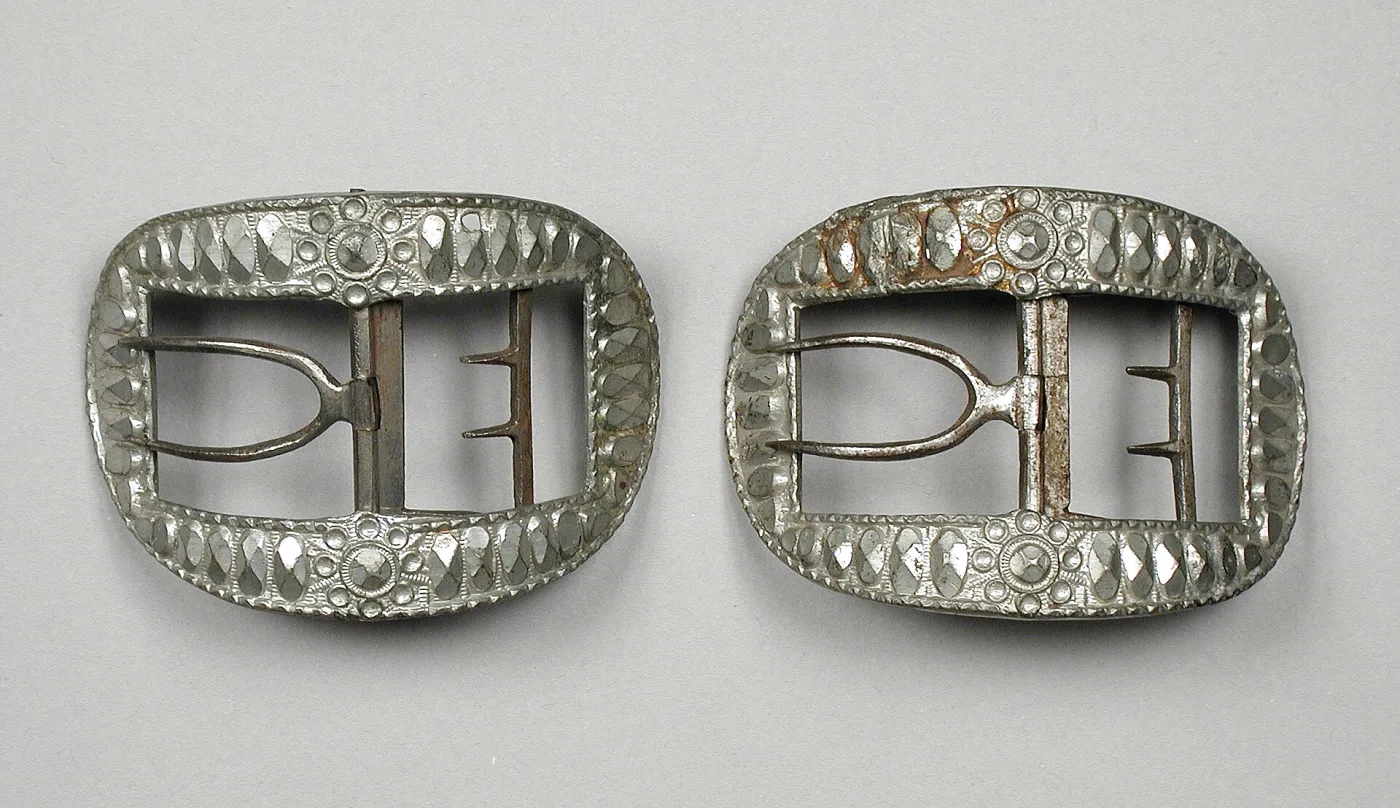
Age fails these two materials in different directions. Cut steel rusts — orange bloom in the crevices, pitting on the stud faces, and studs that have simply corroded away and dropped out. That corrosion is why comparatively little cut steel survives, and it is the one thing cut steel shares with Berlin iron, the matte black cast-iron jewellery of the same decades — the other ferrous antique, and the other one a magnet will find. Marcasite does not rust; instead stones dull, work loose, or are lost from their settings while the silver around them tarnishes grey-black.

Dating Cut Steel by Its Studs
Cut steel was made in England as early as the Elizabethan period, but became a serious industry in the eighteenth century — first at Woodstock, Oxfordshire, then in Birmingham, where Matthew Boulton manufactured it in quantity from the late 1700s. French demand from around 1759 drove both centres hard.
The construction changed as production industrialised, and that gives a usable sequence:
| Feature | What it indicates |
|---|---|
| Screwed studs | Earliest work, associated with Woodstock |
| Riveted studs, up to 15 facets each | The move to Birmingham; finest quality |
| Riveted studs, ~5 facets each | Late nineteenth century, declining quality |
| Stamped strips of studs | Early nineteenth century onward; cheapest, flimsiest |
Treat this as quality tiers, not a calendar. Sources are not uniform on the earliest phase — some trade references describe cut steel as riveted throughout and never mention a screwed one — so a screwed stud suggests early Woodstock work rather than proving it. Facet count is the steadier signal, and even that gives a broad period, not a year.
The stamped-strip tell is the easiest to spot: if studs share a continuous ribbon instead of each having its own rivet, the piece is later and cheaper whatever its style suggests.
Dating Marcasite
Pyrite jewellery has two distinct high points.
The Victorian one is tied to mourning: after Prince Albert’s death restrained ornament became expected, and pyrite’s muted glitter suited a code that ruled out overt gemstones. It belongs in the same conversation as Whitby jet and the other black mourning materials.
The 1920s–30s revival is where most surviving pieces come from. Marcasite in silver suited Art Deco geometry exactly — architectural, linear, monochrome — and was produced in enormous quantity.
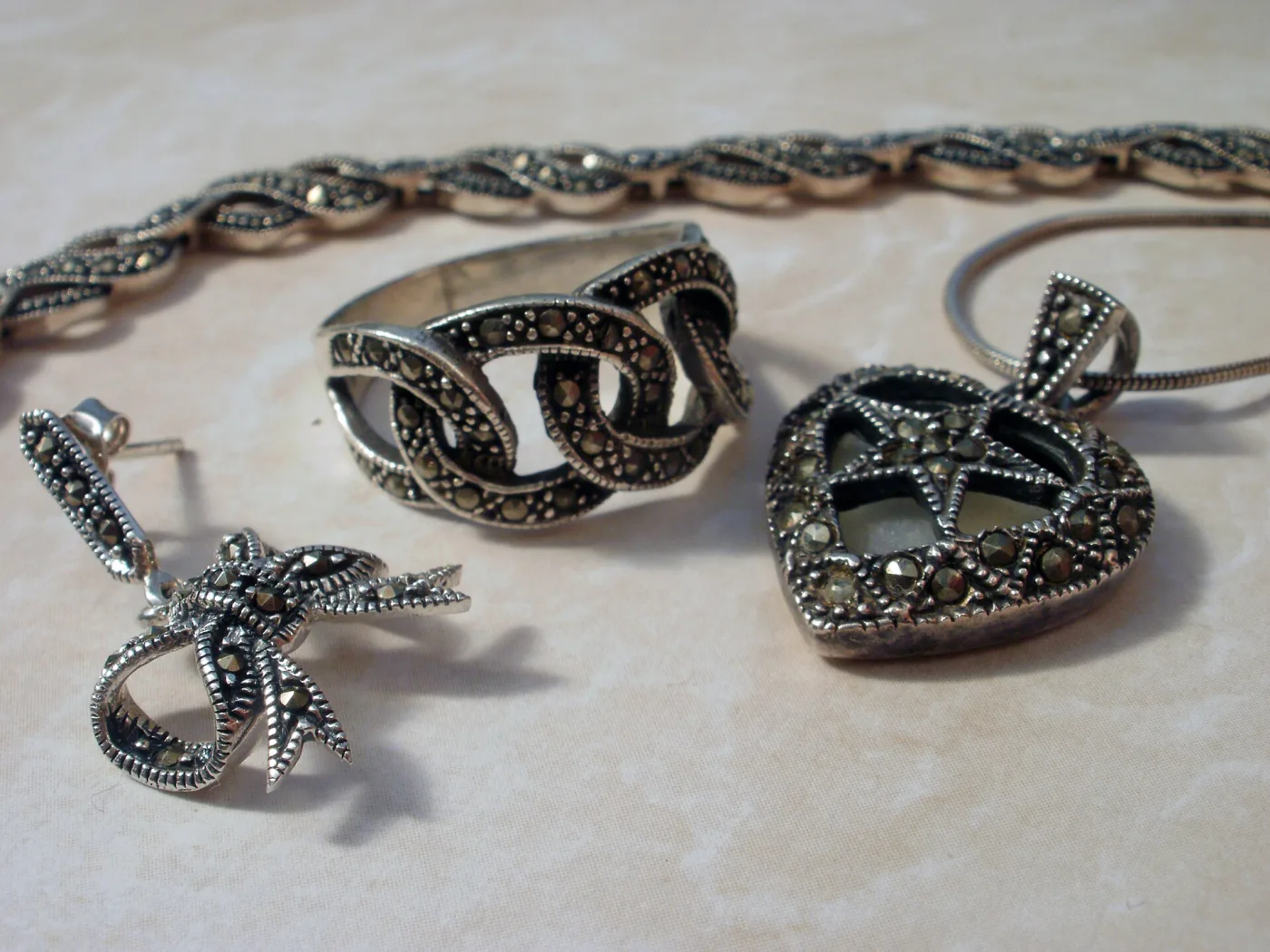

Reproduction is the live risk here, because period pieces are still being used as moulds. The usual advice is that antique stones are mechanically held — bead-set, grain-set, or gripped by tiny curled silver prongs — while cheap modern work is glued in with epoxy.
Sources genuinely disagree on this point, so treat glue carefully. Some references state flatly that genuine marcasite is never glued; others describe period pieces in which stones were glued and secured with curled silver. The defensible version is narrower: an adhesive bead with no mechanical grip at all points to modern mass production, but traces of adhesive alongside proper metalwork do not condemn a piece. Judge the setting first and the glue second.

Identify Before You Clean
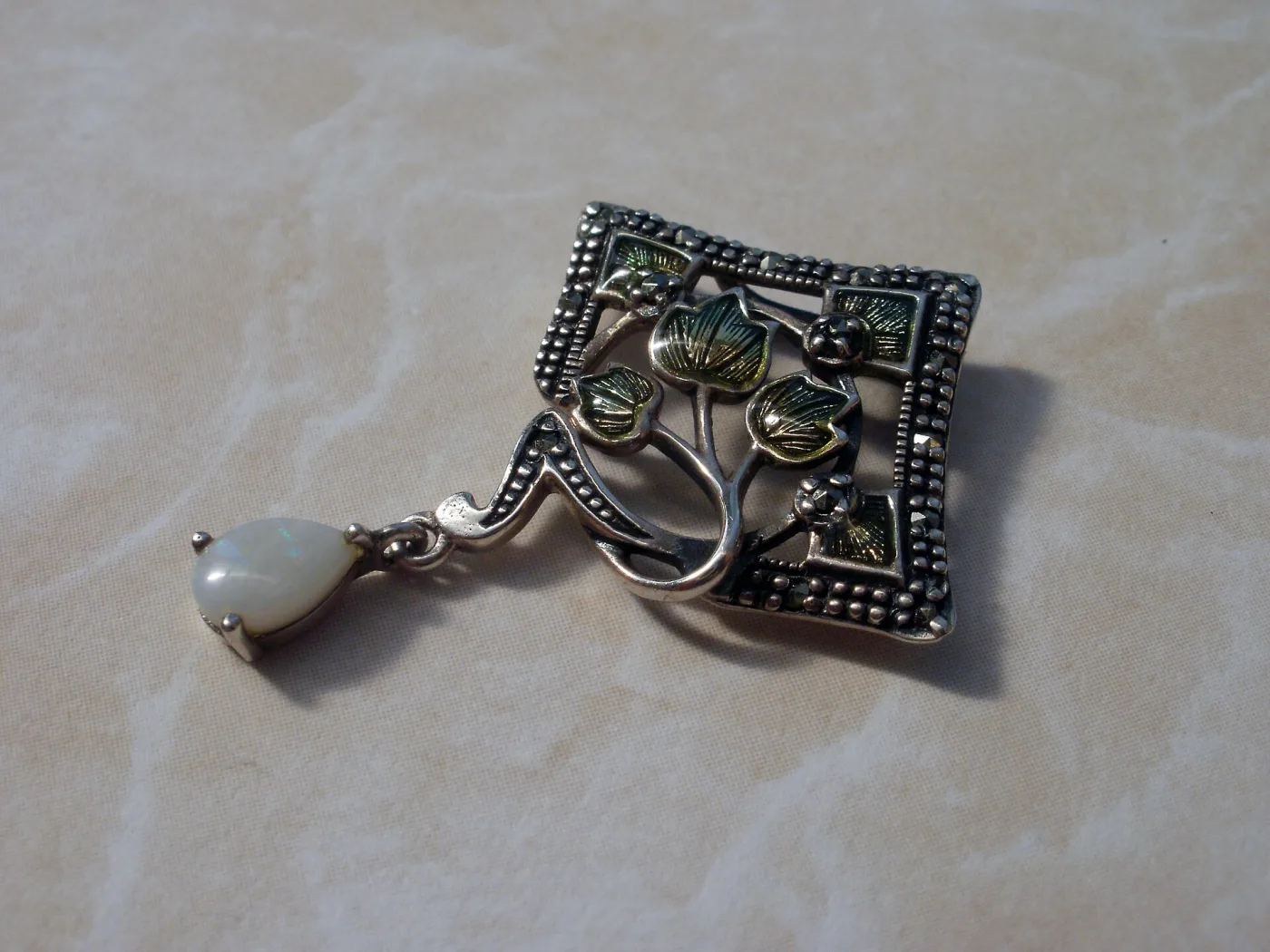
The two want opposite treatment. Cut steel must be kept dry: water in a riveted joint starts rust that cannot be reached, because a riveted stud cannot be taken out without destroying the joint. Marcasite tolerates a dry soft brush but not silver dips or ultrasonics, which loosen stones and attack any adhesive. Either way, a well-meant clean is the fastest way to destroy value.
The One-Minute Verdict
Grey and cold, sparkle in regular flat-topped facets, rivet tails on the back, magnet grabs it: cut steel. Warm and brassy, small irregular domes, silver settings and maybe a hallmark, magnet ignores it: marcasite — which is to say pyrite, wearing a name it was given before anyone knew the difference.
Frequently Asked Questions
Is marcasite jewelry actually made of marcasite?
Almost never. Jewelry sold as marcasite is set with pyrite, which shares the formula FeS2 but crystallizes in the cubic system. True marcasite is orthorhombic, brittle, and can react with atmospheric moisture, so it is unsuitable for wear. The trade name survives from before 1845, when the two minerals were not yet distinguished.
Will a magnet tell cut steel from marcasite?
Usually, yes. Cut steel studs are ferrous and pull firmly toward a small magnet, while pyrite is only weakly paramagnetic and shows no detectable attraction, and its silver mount is not magnetic either. Test the decorated plate rather than a brooch pin or spring, since those are often steel on otherwise silver pieces.
How many facets should a cut steel stud have?
Early hand-faceted studs carry as many as fifteen facets each. By the late nineteenth century that had fallen to about five, and cheaper work used ribbons of studs stamped out by machine rather than faceted and riveted one at a time. Facet count indicates quality and broad period, not a precise year.
Identify Your Jewelry Piece Instantly
Unsure about a hallmark, gemstone cut, or metal stamp? Take a photo and get an instant AI analysis and appraisal.