Berlin Iron Jewelry: Identification & Dating Guide
💡 Key Takeaways (Quick Reference)
- Magnet: Berlin iron pulls firmly. Jet, vulcanite, gutta-percha and black glass do not.
- The black is lacquer, not the metal. Chips reveal orange rust, never a black core.
- Look for assembly: many small castings joined by links, rivets and wire — not one solid piece.
- Style dates it: classical medallions and fretwork early, Gothic tracery from the 1820s–30s.
- Nearly all of it is unsigned. Cut steel is the bright, faceted, riveted cousin — the other ferrous antique.
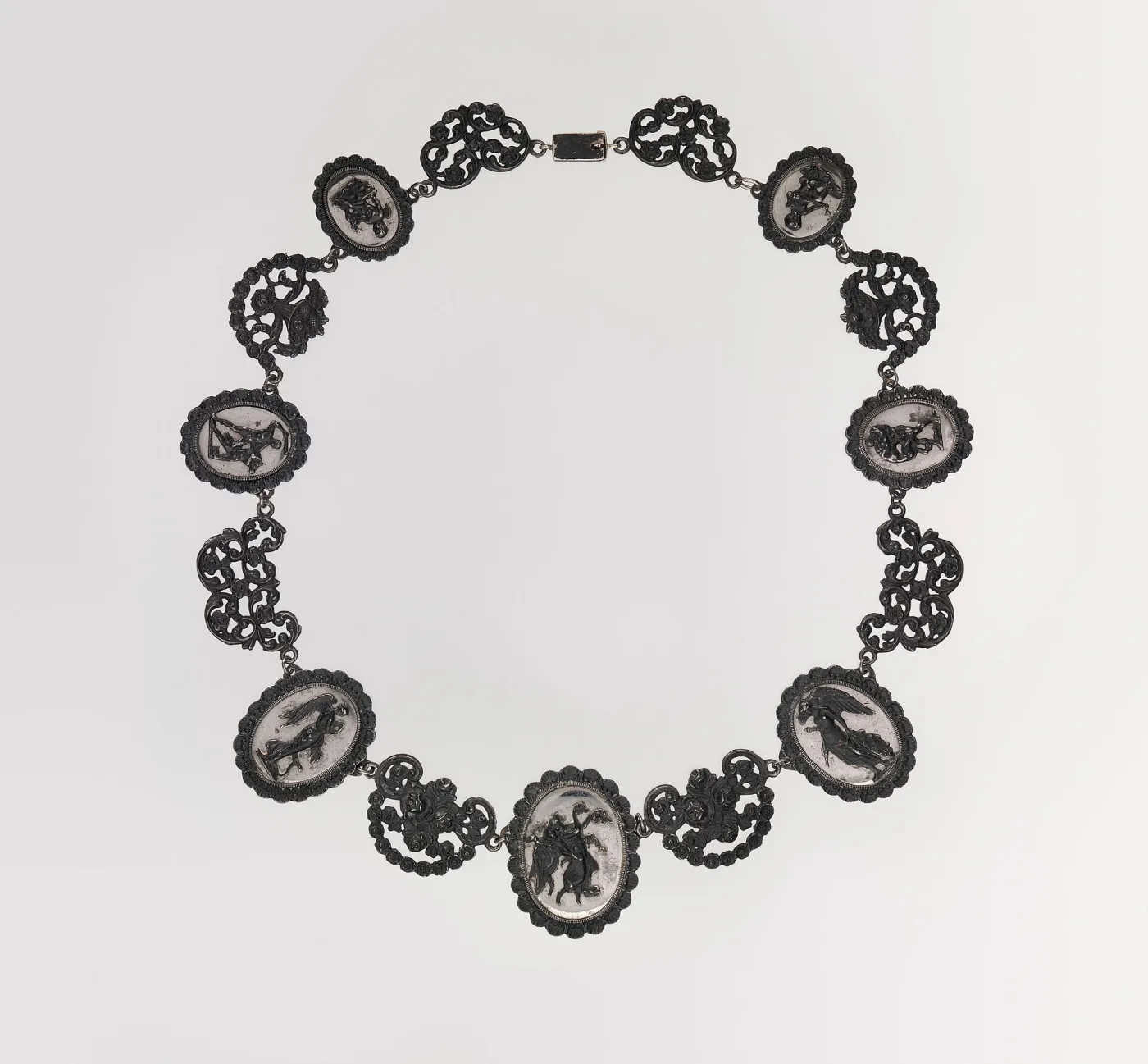
A black openwork necklace, unnervingly light, so finely pierced it looks like lace stiffened with soot. Everyone’s first guess is jet, or some early plastic. It is neither. It is cast iron — poured into moulds so fine that a foundry better known for bridges and railings could turn out a tiara you could crush in one hand.
Berlin iron is one of the few antique materials where identification is genuinely easy once you know the single test, and where the dating is the part that takes work. This guide covers both.
What It Is, and Why Anyone Made Jewellery Out of Iron
Prussia built a decorative iron industry deliberately. A royal foundry opened at Gleiwitz in Upper Silesia in 1796, close to the ore, and its success led to the Königliche Eisengiesserei — the Royal Berlin Foundry — in 1804. Both produced the serious business of the trade: railings, bridges, garden furniture, plaques, vases. The first jewellery came in 1806, beginning with long chains of cast links.
A note on the earliest date. Some trade references push Berlin iron production back to “around 1790”, which sits before the Gleiwitz foundry existed. The documented sequence — Gleiwitz 1796, Berlin 1804, jewellery from 1806 — is the safer one to quote, and a seller dating a piece to the 1790s is relying on the loosest version of the story.
What turned an industrial product into a fashion was the War of Liberation against Napoleon. Between 1813 and 1815 the Prussian royal family asked citizens to hand in gold and silver jewellery to fund the war, giving iron pieces in exchange. Many were inscribed “Gold gab ich für Eisen” — I gave gold for iron — or “Für das Wohl des Vaterlands”, and some carried a portrait of Frederick William III. Wearing black iron stopped being a matter of thrift and became a public statement that you had given your gold away.
Germany tried the same appeal again in 1916 to fund the First World War, with the inscription “Gold gab ich zur Wehr, Eisen nahm ich zur Ehr” — worth knowing, because not every inscribed iron piece is Napoleonic. Production itself outlived the war: it ran through the 1830s and 40s, spread to France and Austria, and declined after about 1850.
The Test That Settles It in Two Seconds
Berlin iron is ferrous. Almost nothing else black and antique is.
Bring a small magnet to the piece and it pulls firmly. Every material it gets confused with — Whitby jet, vulcanite, gutta-percha, bog oak, French jet — is completely unmagnetic. If you are working through a tray of black Victorian jewellery, the magnet sorts the iron out before you have looked at anything else. The full set of tests for the black mourning materials handles everything the magnet leaves behind.
Two cautions. Use a small magnet gently — Berlin iron is brittle, and a rare-earth magnet snapping onto a pierced panel can break it. And test the decorative body rather than a brooch pin or spring, which are often steel regardless of what the ornament is.
| Property | Berlin Iron | Whitby Jet | French Jet (glass) | Vulcanite | Cut Steel |
|---|---|---|---|---|---|
| Material | Cast iron, lacquered | Fossilised wood | Black lead glass | Vulcanised rubber | Faceted carbon steel |
| Magnet | Strong pull | None | None | None | Strong pull |
| Surface | Matte to satin black | Warm, waxy lustre | Bright, glassy | Moulded, can dull to brown | Bright mirror facets |
| Weight | Light for its bulk | Very light | Heavy, dense | Light | Moderate |
| Construction | Many castings, linked | Carved | Moulded or pressed | Moulded | Studs riveted to a plate |
| How it fails | Orange rust under lost lacquer | Chips, crazing | Conchoidal chips | Browns, smells of sulphur | Orange rust, lost studs |
| Peak fashion | c.1806–1850 | 1860s–1880s | Victorian | Victorian | c.1760–1830 |
The trap in that table is the last column. Cut steel is also ferrous and also answers the magnet, so the test separates Berlin iron from jet but not from steel. That pair is settled by eye instead, instantly: cut steel is bright, faceted and reflective, built from studs riveted through a backplate; Berlin iron is matte black cast openwork. Nothing about them looks alike.
How It Was Made, and What the Method Leaves Behind
The standard account is that models were carved or moulded in wax, pressed into very fine sand to leave an impression, and molten iron poured in. Castings were cooled, hand-finished — filed, cleaned up, fettled — and then sealed with black lacquer.
Sources do not agree on the moulds. Most jewellery references describe fine sand moulds; others describe metal chill moulds, and note that the iron was selected for fluidity, with phosphorus content cited as high as about 0.7% to let it run into fine detail. Either way the point holds — this was iron prepared to fill a jeweller’s mould — but a confident claim about the exact process on a specific piece is more confident than the literature.
Three things follow from the method, and all three are visible.
It is assembled, not carved. A Berlin iron necklace is a set of separate small castings joined by links, rivets and wirework, and turning it over shows that plainly — individual elements, individual joints. A black openwork piece that is obviously one solid moulding is not this.
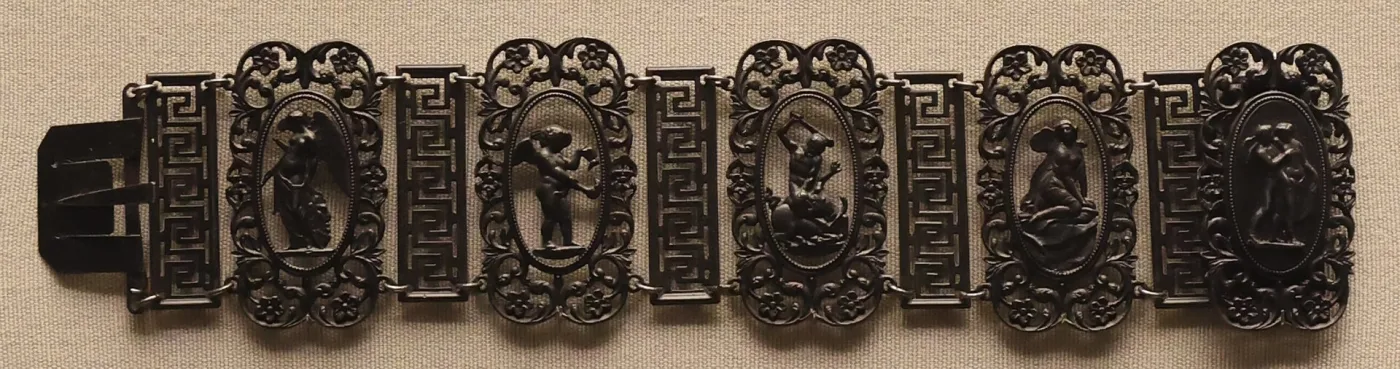

The black is a coating. This matters more than it sounds. Bare cast iron rusts, so the lacquer is what has kept these pieces alive for two centuries. Where it has worn or chipped you find orange corrosion underneath — never a black core, the way jet or vulcanite would show. A piece that has been stripped, over-cleaned or “restored” with modern paint has lost both its protection and most of its value.
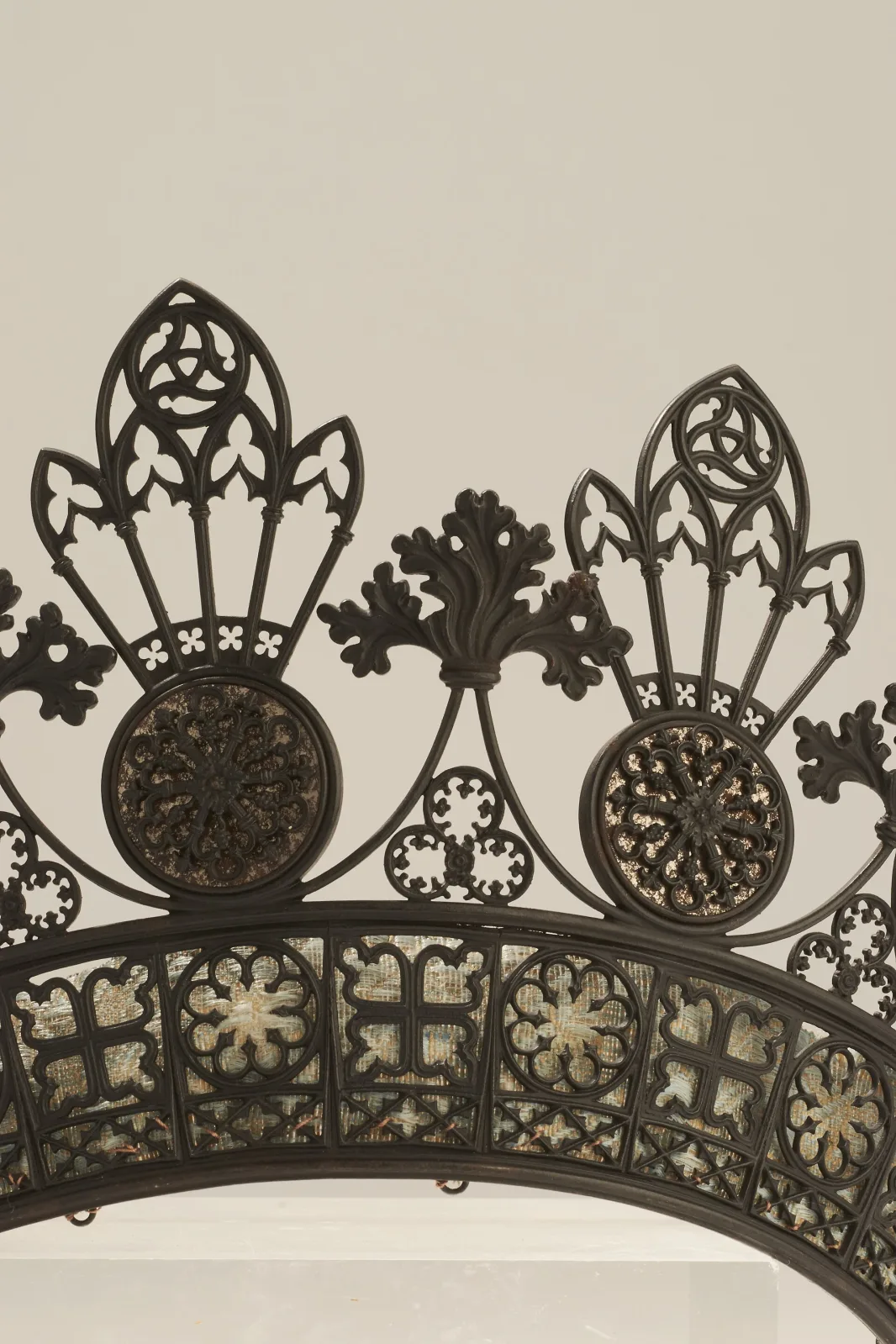
The casting can be astonishingly fine, and that fineness is the quality tell. Look at the tracery at magnification rather than at arm’s length.
.jpg)
Casting is not the only technique. The other is wirework — chains of fine drawn-iron links built into a dense mesh, often carrying a cast pendant. A piece may use both.
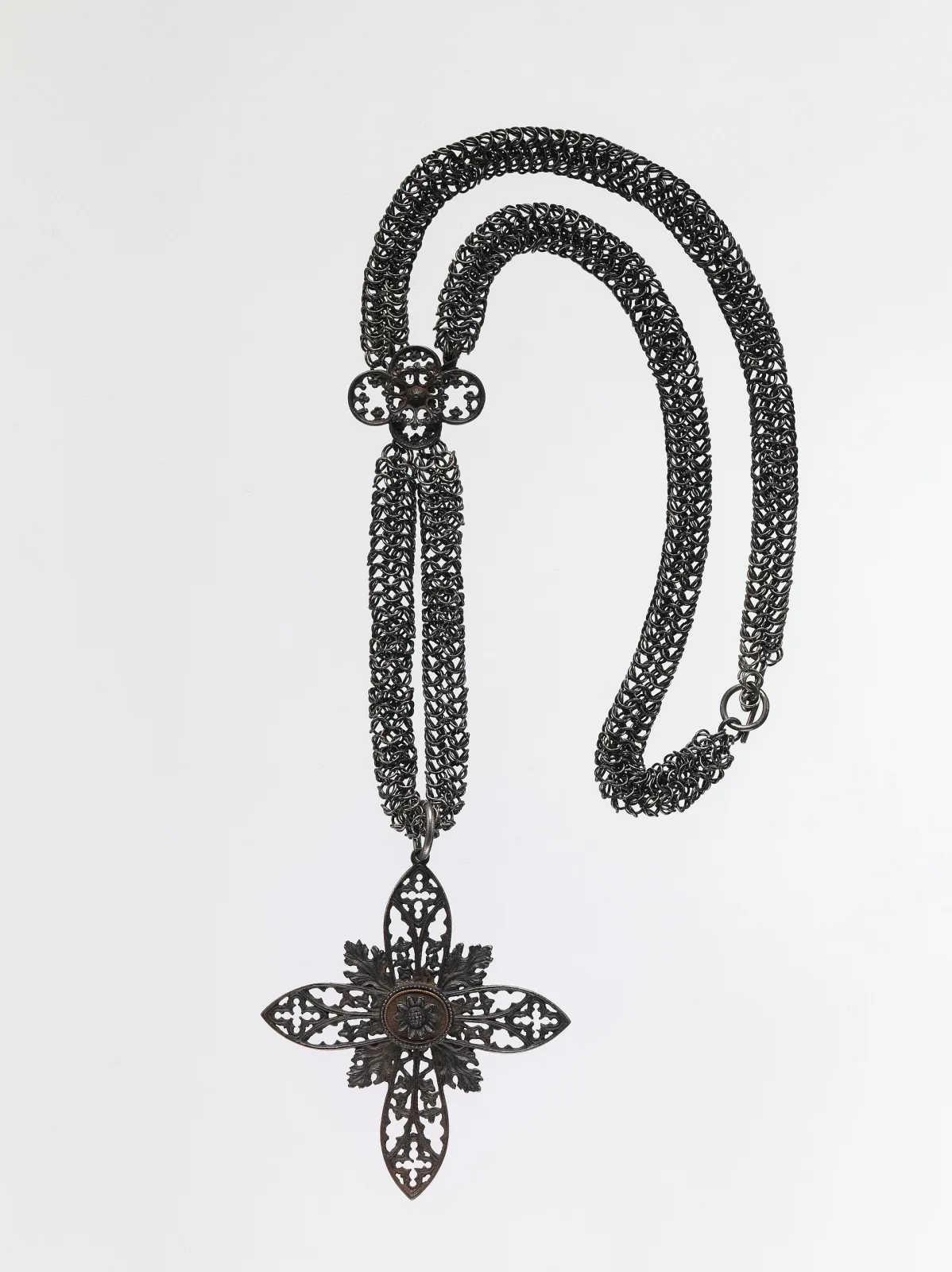

That French connection carries a story — that Napoleon took the casting moulds from Berlin, and fer de Berlin was made in Paris from them. Treat it as trade tradition, not established fact. What is not in doubt is that French and Austrian production existed: a piece can be in the Berlin manner without being from Berlin.
Dating by Style
With almost no marks to read, style is the main dating instrument. The vocabulary moves in a recognisable direction.
| Period | Design vocabulary | What you see |
|---|---|---|
| c.1806–1815 | Neoclassical | Classical figures in relief, cameo-like medallions, palmettes, acanthus, Greek-key fret |
| c.1815–1825 | Neoclassical loosening | More naturalistic foliage and flowers alongside the classical repertoire |
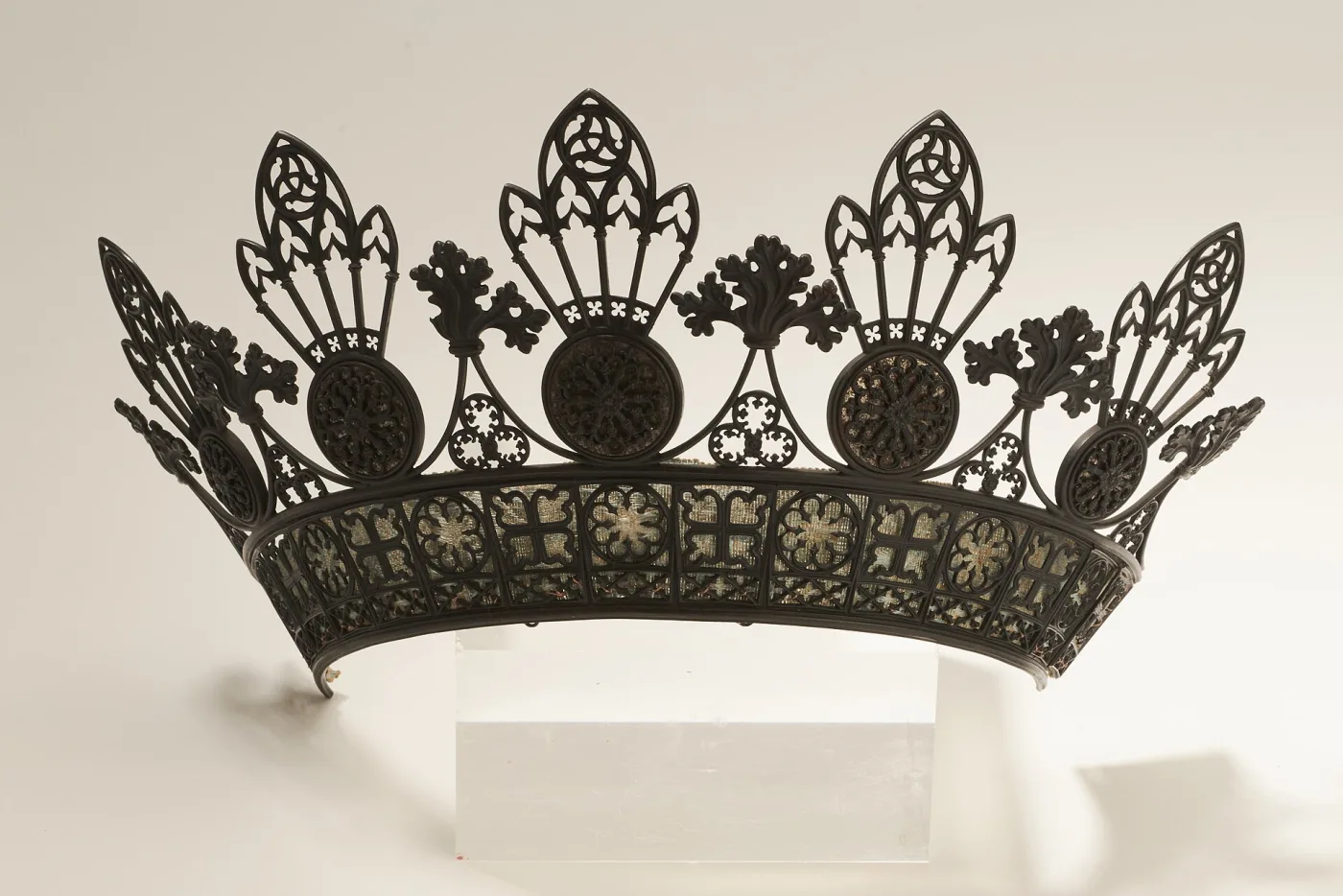
| c.1825–1850 | Gothic Revival | Pointed arches, trefoils and quatrefoils, rose windows, tracery, oak leaves |
The early language is the language of antiquity, echoing the Wedgwood and Tassie cameos fashionable jewellery already used — a black iron medallion standing in for a carved shell or hardstone cameo.
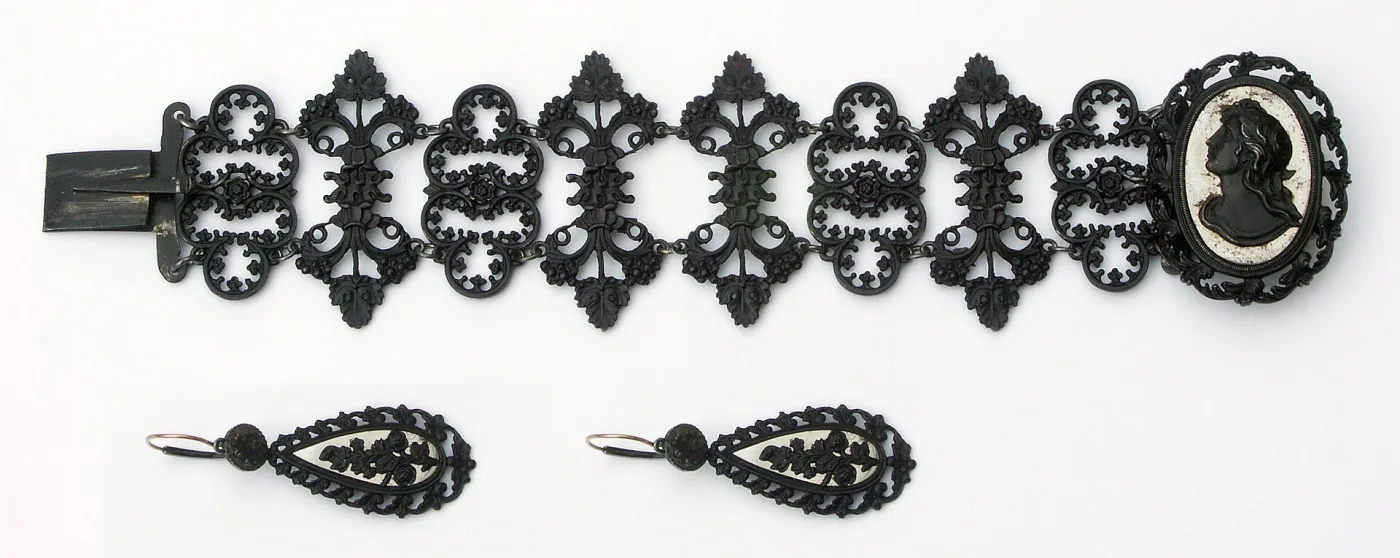

Then the arches arrive. Gothic Revival forms are the strongest single dating signal in Berlin iron, because they are unmistakable and because they are late.
.jpg)
Sources disagree on when the Gothic phase starts, and the spread matters. One reference puts Gothic motifs as early as 1810; others place them after 1815 and dominant by the 1830s; another dates the shift to about 1825. Dated objects sit with the later reading — the tiara above is catalogued at c.1825. So Gothic tracery indicates the 1820s at the earliest, more usually the 1830s–40s, and that early outlier is not a licence to call a Gothic piece Napoleonic.
Marks: Expect None
Most Berlin iron is unsigned. That is the normal condition, not a red flag, and it is why the style table above does more work than any hallmark.
A few manufacturers did mark their output. The names recorded are Geiss, Devaranne, Lehmann and Hossauer, with signatures such as Geiss à Berlin noted in the trade literature. Siméon Pierre Devaranne (1789–1859) is the best documented: recorded as a manufacturer of cast-iron wares in 1828 and as a foundry owner by 1850, exhibiting in Berlin in 1822, 1827 and 1842, and showing cast-iron jewellery at the Great Exhibition in London in 1851. Johann Conrad Philipp Geiss (1771–1846) is the other name to know, and the one most often attributed on stylistic grounds.
A genuine signature is uncommon enough to be worth real money. Its absence tells you nothing at all.
Where a piece is mounted — a medallion in a gold or silver bezel, a clasp in another metal — the mount may carry marks even though the iron does not, and those are worth chasing. British silver hallmarks will date a mount far more precisely than style will ever date the iron, and the findings on a brooch read the same way.
Condition, and What Not to Do
Berlin iron fails in one direction only: rust, once the lacquer is breached. Everything follows from protecting that coating.
Keep it dry. Do not polish it — polishing removes the lacquer holding the rust off, and an original finish cannot be put back. No silver dips, no ultrasonics. Do not “improve” a dull piece either: the surface is meant to be matte to satin, and a suspiciously glossy black is usually modern paint over stripped or corroded iron.
Brittleness is the other risk. Cast iron does not bend, it breaks, and a fine pierced panel has almost no margin.
The One-Minute Verdict
Black, light, lacy, and the magnet grabs it: Berlin iron. Chips show orange rust, not a black core. Turn it over and count the separate castings and their links — assembly is the method’s fingerprint. Then read the ornament: classical medallions, palmettes and Greek fret put it early, in the 1806–1820s window that includes the Gold gab ich für Eisen years; pointed arches, trefoils and rose windows put it in the 1820s–40s.
And expect no signature. In a field where almost nothing is marked, the object itself is the document.
Frequently Asked Questions
Will a magnet identify Berlin iron?
Yes, and it is the fastest test available. Berlin iron is cast iron and pulls firmly toward a small magnet, while jet, vulcanite, gutta-percha, bog oak and black glass show no attraction at all. Use a small magnet gently, because a strong rare-earth magnet snapping onto brittle openwork can break it.
Is Berlin iron jewelry usually signed?
No. The great majority is unsigned, and attribution is normally made by comparing a piece with documented examples rather than by reading a mark. A few manufacturers did stamp their names, with Geiss, Devaranne, Lehmann and Hossauer the names most often recorded, so a genuine signature is uncommon and adds considerable value.
Why is Berlin iron jewelry always black?
The black is a lacquer, not the colour of the metal. Bare cast iron rusts quickly, so pieces were hand-finished after casting and then coated in black lacquer to seal them. Where that coating has been lost you see orange corrosion underneath, which is why a piece stripped of its lacquer is both less stable and worth far less.
Identify Your Jewelry Piece Instantly
Unsure about a hallmark, gemstone cut, or metal stamp? Take a photo and get an instant AI analysis and appraisal.