Roman Micromosaic Jewelry Identification & Dating Guide
💡 Key Takeaways (Quick Reference)
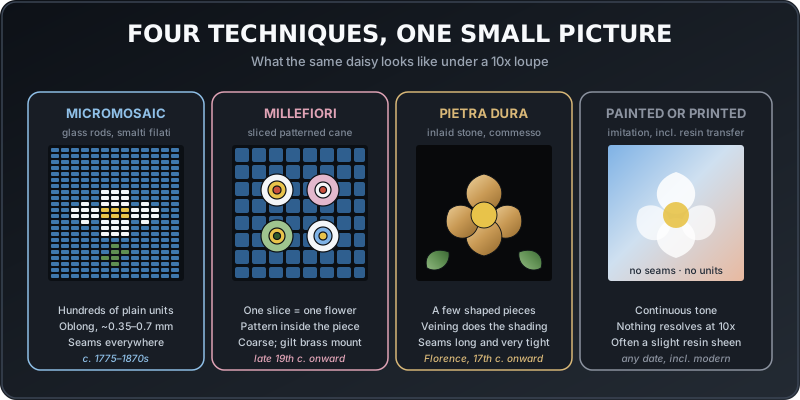
- Micromosaic is built, not painted. Under a loupe the image breaks into separate oblong glass tesserae with visible seams.
- One slice or many pieces? A whole flower in a single unit is millefiori — later, cheaper, usually in gilt brass.
- Glass or stone? Few large shaped pieces with veining running through them means pietra dura, not micromosaic.
- The ground is usually not mosaic. The field around the picture is normally a solid slab of glass or black stone; only the reserve is worked.
- Numbers on the back are collection marks, not dates.
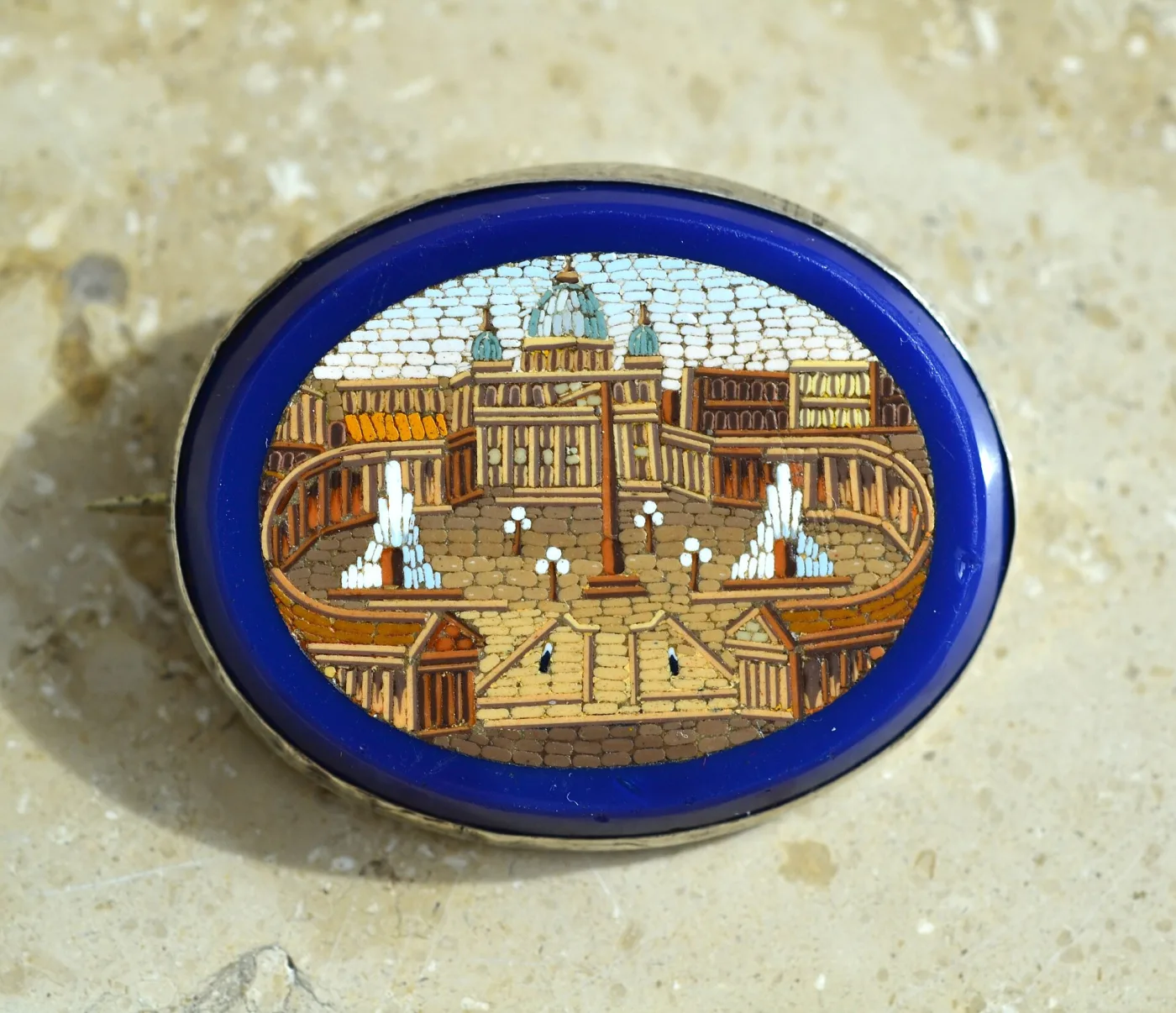
A blue oval showing Saint Peter’s Square. A dove on a bright ground. A spaniel, a goat, a spray of fruit. These turn up constantly in inherited jewellery boxes, and almost nobody who owns one can say what it is made of — the surface is smooth, the colours are painterly, and the natural assumption is that somebody painted it very carefully on porcelain.
Almost none of them are painted. They are mosaics, assembled from glass rods drawn out to less than a millimetre, and once you have seen the structure under magnification you cannot unsee it. The harder question is not is this a mosaic but which kind — because at least three different techniques and one outright imitation all end up as a small picture in a metal bezel.
What a Micromosaic Actually Is
The material is smalti filati — spun enamel. Opaque coloured glass is heated and drawn into fine rods, then chopped into tesserae, set into a bed of mastic on a tray or slab, and finally waxed and polished flat. The mosaicist works with tweezers, placing each piece.
The technique came out of the Vatican Mosaic Studio, which was set up under Pope Gregory XIII to translate the deteriorating altarpieces of St Peter’s into mosaic; sources date its foundation to 1576 and its formal opening as a studio to 1727, which is less of a contradiction than it looks — the workshop long predates its constitution. What matters for jewellery is what happened next. Around 1775, Giacomo Raffaelli and Cesare Aguatti pushed the tesserae small enough to make portable pictures, and the Grand Tour supplied the market.
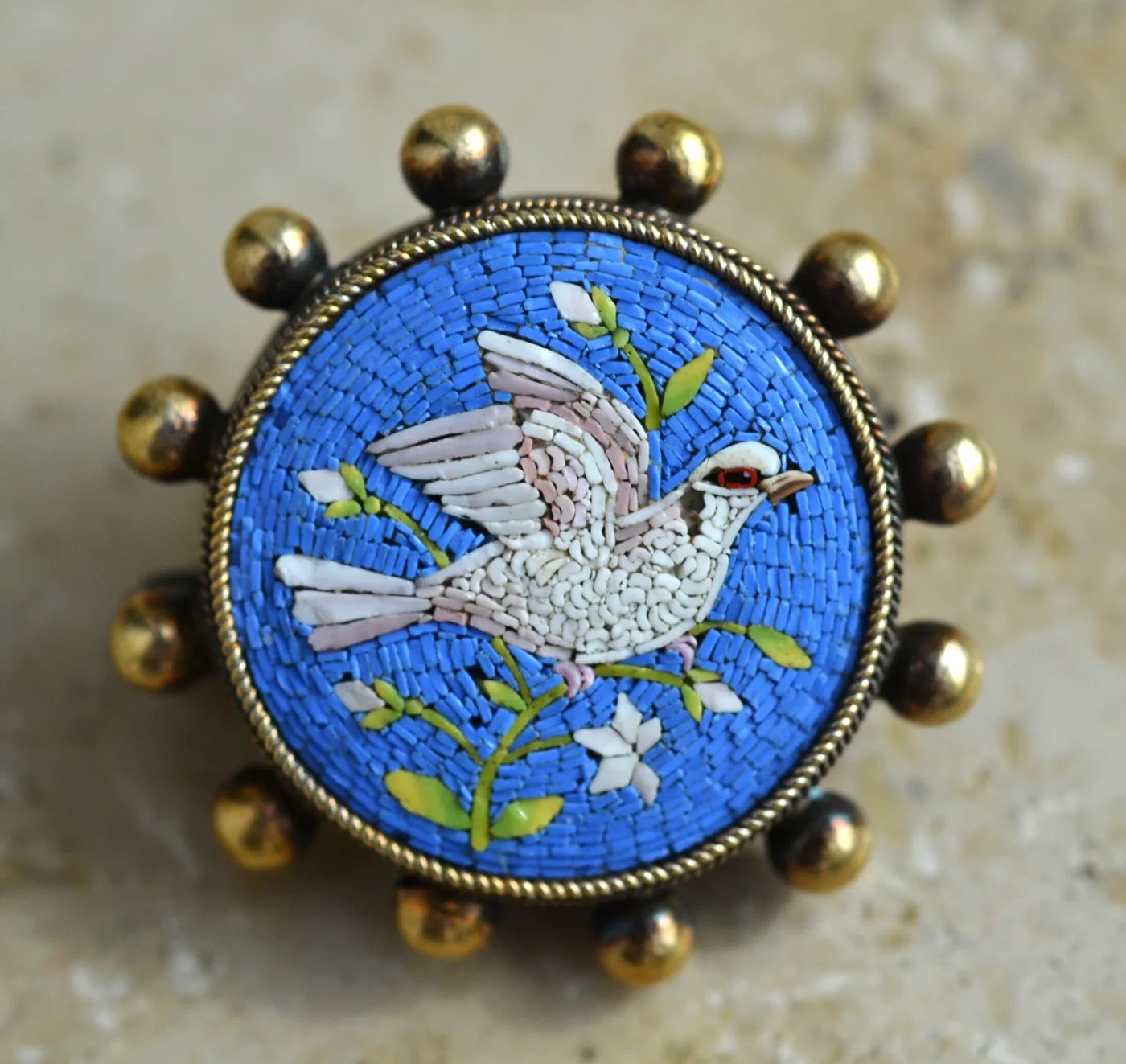
The subjects follow the market exactly. Travellers wanted Rome: the Colosseum, the Forum, Saint Peter’s, the Roman campagna with its goats and peasants. They also wanted the Doves of Pliny — a Roman mosaic of four doves on the rim of a basin, excavated at Hadrian’s Villa in 1737 and installed in the Capitoline Museums in 1765, which became the single most copied subject in the medium. A brooch with one dove and an olive sprig, like the one at the top of this page, is drawing on that fashion without being a copy of it.
The Four Things It Might Be
| Micromosaic | Millefiori | Pietra dura | Painted | |
|---|---|---|---|---|
| Material | Glass rods (smalti filati) | Sliced patterned cane | Semi-precious stone | Paint, enamel or print |
| Unit size | Under 1 mm, often ~0.4 mm | 1–4 mm | Whole shapes, 5 mm+ | None |
| Unit shape | Oblong; curved where hair or fur is shown | Round or polygonal, patterned | Irregular, cut to the drawing | — |
| How an image is built | Hundreds to thousands of plain units | One slice = one whole flower | A few shaped pieces butted together | Continuous tone |
| Seams | Fine, everywhere, regular | Wide, filled | Long, curved, very tight | None |
| Colour within one unit | Flat | Patterned | Graded — the stone’s own veining | — |
| Typical ground | Glass or black stone slab | Glass, often coarse | Black marble or onyx | Anything |
| Typical mount | Gold, later silver or gilt metal | Stamped gilt brass | Gold or gilt metal | Anything |
| Typical period | c. 1775 – 1870s | Late 19th c. onward | 17th c. onward; jewellery mostly 19th c. | Any, including modern |
Two cautions on that table. The period column describes when each technique dominated, not a boundary — fine micromosaic work continued after the 1870s in small quantities, and pietra dura is still made in Florence today. And “micromosaic” is used loosely in the trade to cover millefiori souvenir work, so a seller’s description is not evidence of technique.
Five Checks That Settle It
1. Look for the Seams
This is the whole test, and a 10x loupe does it. A micromosaic is discrete: the image is made of units, and between the units are seams. Painted and printed imitations have continuous tone. Modern resin transfers have a slight surface sheen and no structure at all under magnification.

2. Judge the Shape of the Units, Then the Count
Micromosaic tesserae are characteristically oblong, not square — they are cut from a drawn rod, so length is arbitrary and width is not. Where the subject calls for hair or fur, good Roman work uses curved, comma-shaped tesserae, a refinement credited to Antonio Aguatti and associated with work of the 1830s–40s.
Density is the usual measure of quality, and here published figures genuinely disagree: reference sources put the finest work at 3,000–5,000 tesserae per square inch, some trade sources say up to 1,400, and Italian sources quote over 800 per square centimetre — which is roughly 5,200 per square inch, at the top of the first range rather than in agreement with the second. Do not quote any of them as a threshold.
The usable version is linear and you can check it with a loupe: those densities correspond to individual tesserae roughly 0.35 to 0.7 mm across, so fine work fits somewhere between about 35 and 70 tesserae in a single inch. Count across a span you can measure instead of trying to judge an area. Coarse units you can resolve with the naked eye mean later, cheaper, or a different technique entirely.

3. Ask Whether a Flower Arrived Whole
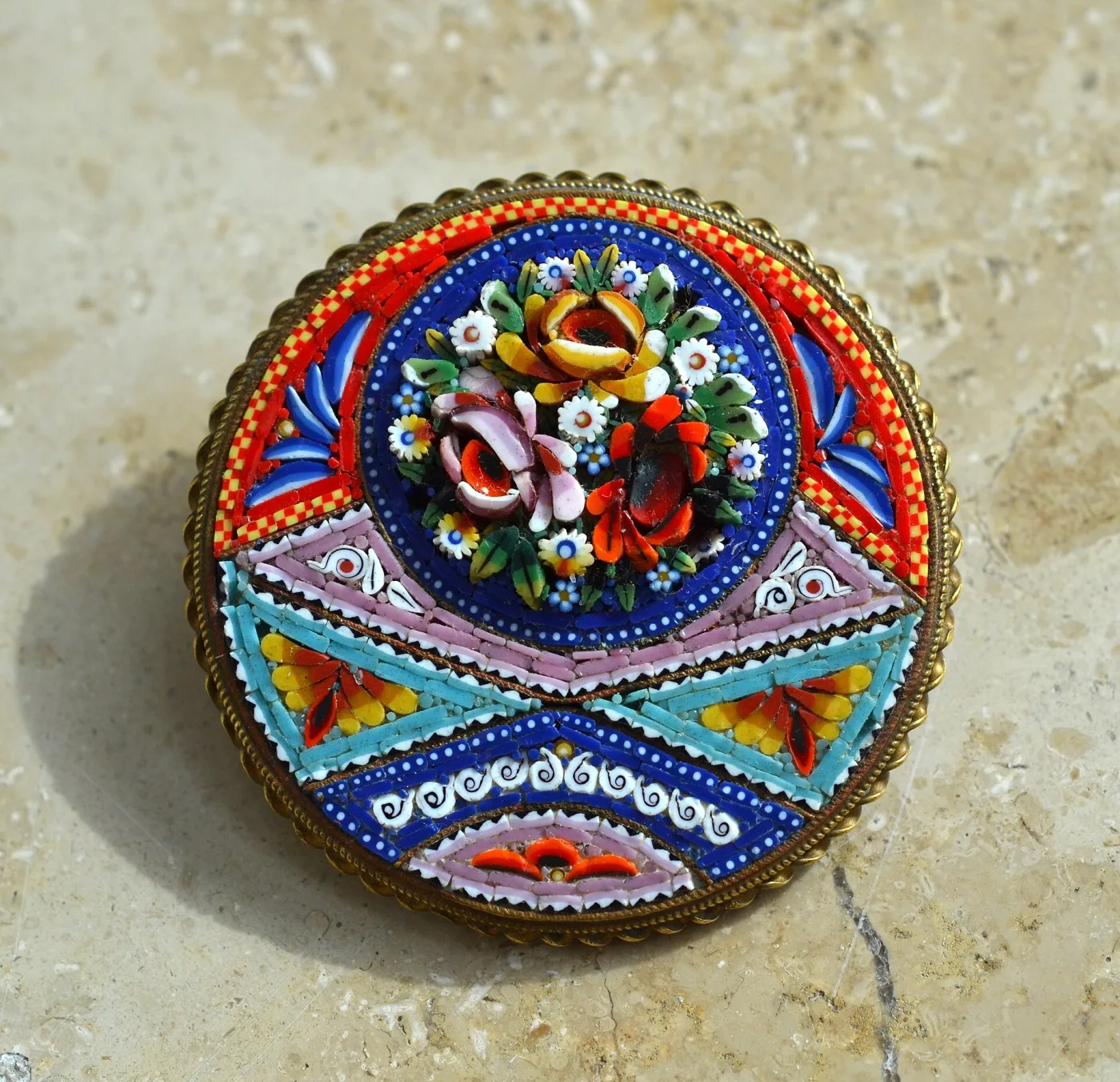
This is the fastest way to separate true filati work from millefiori, and it needs no measurement. Millefiori is made by slicing a patterned glass cane, so the pattern is already inside the slice: a daisy appears complete, centre and petals together, in one piece. In a filati micromosaic that same daisy would be assembled from a dozen or more plain tesserae.
Whole-flower construction is not a forgery — it is a legitimate and much older glass technique — but in jewellery it almost always indicates later, cheaper, higher-volume work.

4. Glass or Stone?
Pietra dura — Florentine mosaic, properly commesso — is inlaid stone, and it behaves nothing like glass. It uses comparatively few pieces, each cut to the shape it depicts: a whole petal is one slice of stone, chosen so that the natural banding within it does the shading. The seams are long, curved and extremely tight, and the motifs run to flowers, birds and butterflies on a black ground.
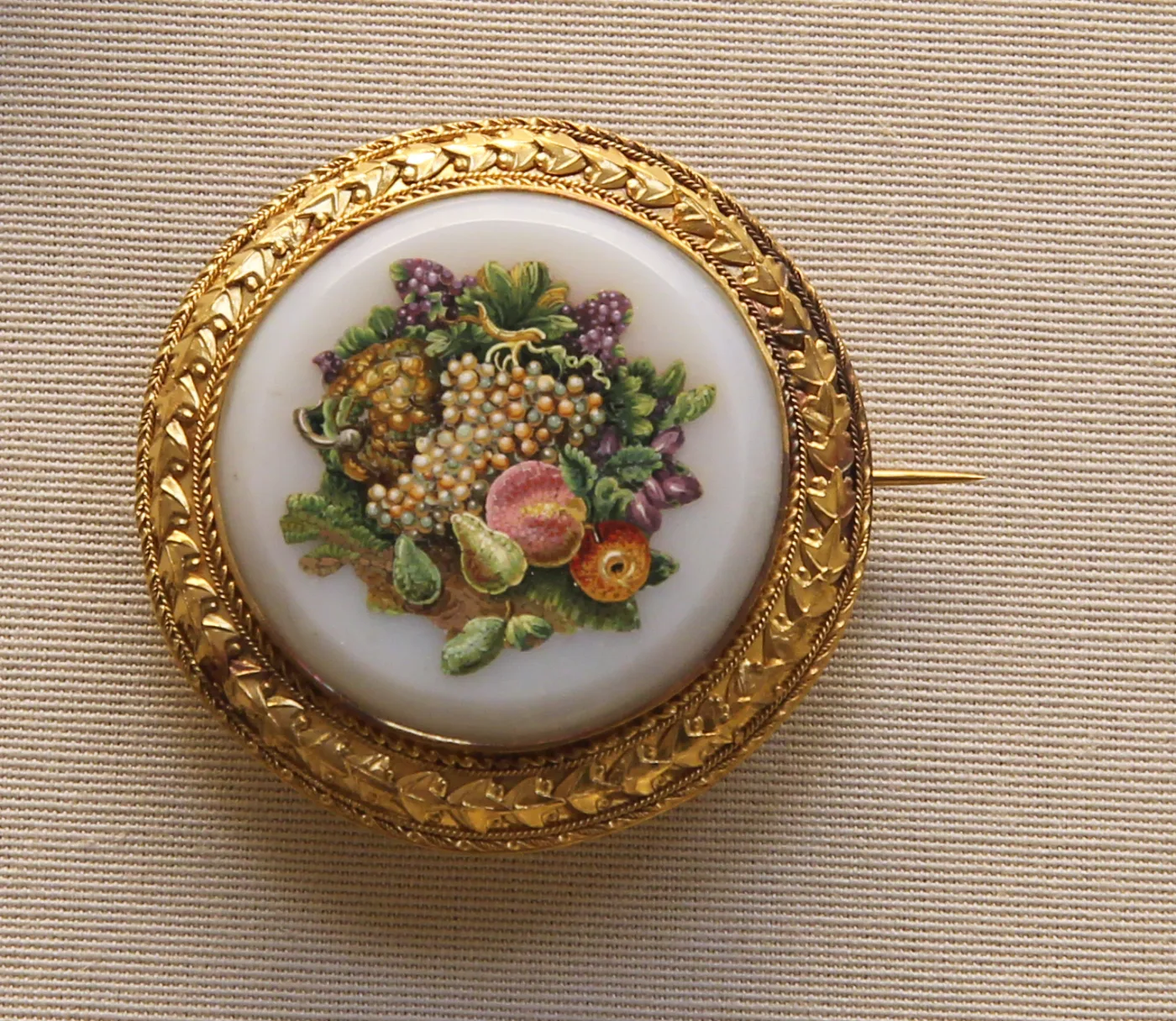
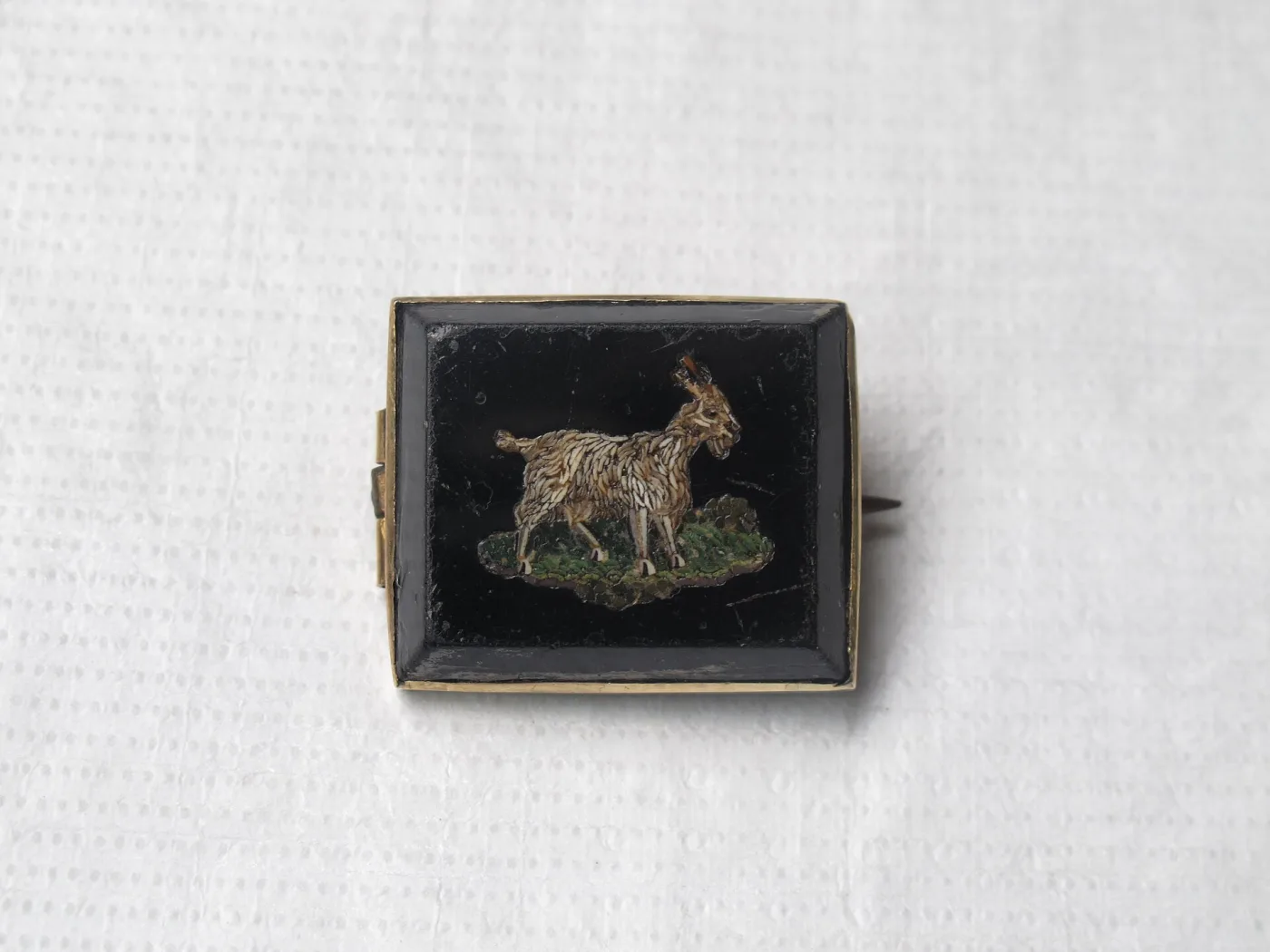
The confusion between the two is not a beginner’s mistake. It runs through the trade and into institutional records, as the next piece shows.
.jpg)
5. Turn It Over
The back settles the construction and often dates the piece, which is the same logic that lets you date an antique brooch from its pin, hinge and catch.
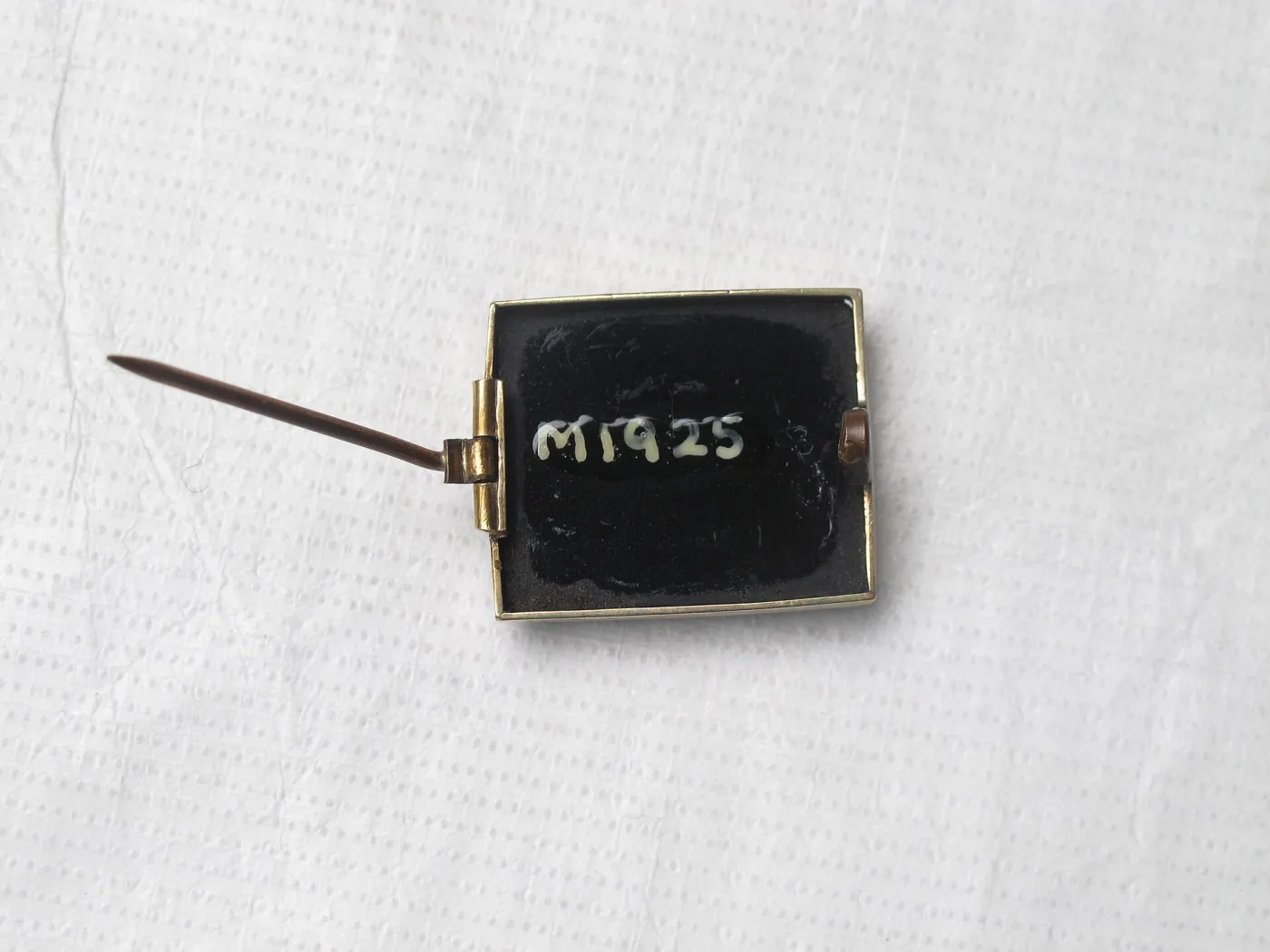
Expect a solid slab — glass, black marble or onyx — held by a metal frame, with no separate backplate. The mount is the datable part: early and better work is set in gold, sometimes with a chased or cannetille frame, and a karat mark or assay stamp will do more for the date than the mosaic can, which is what the gold purity stamps and British sterling silver hallmark sequences are for. Stamped gilt brass with a scalloped or gadrooned edge is late souvenir work.
Signatures exist and are worth hunting for. The Barberi brooch above is signed on its reverse; named Roman mosaicists signed the back of the plaque, not the face.
.jpg)
Dating by Quality Drift
There is no date letter on a micromosaic, and the subject alone will not date one — the Colosseum sold for a century. What does move is the standard of work, and it moves in one direction.
| Feature | What it indicates |
|---|---|
| Very fine filati, classical or architectural subject, gold mount, signed | Late 18th to mid 19th century; the top of the market |
| Fine filati, curved tesserae for fur and hair | Roman work associated with the 1830s–40s |
| Coarser filati, floral subjects displacing classical ones | Later 19th century, as volume rose |
| Millefiori canes, chunky borders, stamped gilt brass | 20th century souvenir production |
| No visible units at all under a loupe | Painted, printed or a modern resin transfer |
Read that as a quality sequence rather than a calendar. Fine work and coarse work were made side by side in the same decades for different purses, so a coarse piece is cheap for its date rather than necessarily late — the gradient tells you where in the market a piece sat, and only loosely when.
These were souvenirs of the same journeys that produced lava and shell cameos, and the two are often found in one box, bought on one trip.
Do Not Clean It
Micromosaic is a bed of small glass pieces held in mastic, wax and polish. Water gets under the tesserae and lifts them; ultrasonic cleaners empty a plaque quickly and irreversibly; solvents attack the wax fill between the units and leave a pitted surface. Lost tesserae cannot be replaced, because the original rod colour no longer exists — each pull of glass produced a shade that was never duplicated.
A dry, soft brush is the entire permitted procedure.
The One-Minute Verdict
Break the image into units under a loupe and the answer follows. Many small oblong glass pieces, flat in colour, seams everywhere: micromosaic. Whole flowers arriving in single patterned slices: millefiori, and probably twentieth century. Few large stone shapes with veining doing the shading and seams you can barely find: pietra dura. No units at all: it is painted, and whatever the seller called it, it is not a mosaic.
Frequently Asked Questions
How can I tell a real micromosaic from a painted imitation?
Use a 10x loupe and look for structure. A micromosaic is built from separate glass tesserae, so you will see seams between them and the image will break into discrete units, usually oblong rather than square. A painted or printed imitation has continuous tone and no seams, and the surface under raking light is uniform rather than faintly quilted.
What is the difference between micromosaic and millefiori?
In a true Roman micromosaic each tessera is a plain rod of coloured glass and the picture is built from hundreds or thousands of them. Millefiori uses slices of patterned cane, so an entire flower appears complete in a single piece. If you can see whole daisies with their centres already formed, you are looking at millefiori, which generally means later and cheaper work.
Is micromosaic the same as pietra dura?
No. Micromosaic is glass; pietra dura, also called Florentine mosaic, is inlaid semi-precious stone. Pietra dura uses relatively few shaped stone pieces fitted edge to edge, so the seams are long and curved and the colour shifts within a single piece follow the stone's own veining. Micromosaic uses many small units of uniform colour. The two are confused constantly, including in museum records.
Identify Your Jewelry Piece Instantly
Unsure about a hallmark, gemstone cut, or metal stamp? Take a photo and get an instant AI analysis and appraisal.